


Logo Planète Astronomie
Télescope chez astroshop


Sauter la navigation
  • Système Solaire
    • Le Système Solaire
    • Le Soleil, notre étoile
      • Photos du Soleil, notre étoile
      • Vidéos du Soleil, notre étoile
    • Planète Mercure
      • Photos de la planète Mercure
      • Vidéos de la planète Mercure
    • Planète Vénus
      • Photos de la planète Vénus
      • Vidéos de la planète Vénus
    • Planète Terre
      • Photos de la planète Terre
      • Vidéos de la planète Terre
    • Planète Mars
      • Photos de la planète Mars
      • Vidéos de la planète Mars
      • Les satellites de Mars
        • Phobos, satellite de Mars
          • Photos de Phobos
        • Deimos, satellite de Mars
          • Photos de Deimos
    • Planète Naine Cérès
      • Photos de la planète naine Cérès
    • Planète Jupiter
      • Photos de la planète Jupiter
      • Vidéos de la planète Jupiter
      • Les satellites de Jupiter
        • Photos des satellites de la planète Jupiter
        • Io, satellite de Jupiter
          • Photos de Io
        • Europe, satellite de Jupiter
          • Photos de Europe
        • Ganymède, satellite de Jupiter
          • Photos de Ganymède
        • Callisto, satellite de Jupiter
          • Photos de Callisto
    • Planète Saturne
      • Photos de la planète Saturne
      • Vidéos de la planète Saturne
      • Les anneaux de Saturne
        • Photos des anneaux de Saturne
      • Les satellites de Saturne
        • Photos des satellites de Saturne
        • Satellites mineurs de Saturne
          • Photos des satellites mineurs de Saturne
        • Mimas, satellite de Saturne
          • Photos de Mimas
        • Encelade, satellite de Saturne
          • Photos d'Encelade
        • Téthys, satellite de Saturne
          • Photos de Téthys
        • Dioné, satellite de Saturne
          • Photos de Dioné
        • Rhéa, satellite de Saturne
          • Photos de Rhéa
        • Japet, satellite de Saturne
          • Photos de Japet
        • Titan, satellite de Saturne
          • Photos de Titan
    • Planète Uranus
      • Photos de la planète Uranus
      • Vidéos de la planète Uranus
      • Les anneaux d'Uranus
        • Photos des anneaux d'Uranus
      • Les satellites d'Uranus
        • Photos des satellites d'Uranus
        • Satellites mineurs d'Uranus
          • Photos des satellites mineurs d'Uranus
        • Miranda, satellite d'Uranus
          • Photos de Miranda
        • Ariel, satellite d'Uranus
          • Photos d'Ariel
        • Umbriel, satellite d'Uranus
          • Photos d'Umbriel
        • Titania, satellite d'Uranus
          • Photos de Titania
        • Obéron, satellite d'Uranus
          • Photos de Obéron
    • Planète Neptune
      • Photos de la planète Neptune
      • Vidéos de la planète Neptune
      • Les satellites de Neptune
        • Photos des satellites de Neptune
        • Satellites mineurs de Neptune
          • Photos des satellites mineurs de Neptune
        • Triton, satellite de Neptune
          • Photos de Triton
    • Planète naine Pluton
      • Photos de la planète naine Pluton
      • Vidéos de la planète naine Pluton
      • Les satellites de Pluton
        • Photos de Pluton, Charon, Nix, Hydra
    • Planète naine Eris
    • Planète naine Makemake
    • Planète naine Haumea
  • Exoplanètes
  • Photos d'astronomie
    • Photos du Soleil, notre étoile
    • Photos de la planète Mercure
    • Photos de la planète Vénus
    • Photos de la planète Terre
      • Photos de la Lune
    • Photos de la planète naine Cérès
    • Photos de la planète Mars
      • Galerie de photos de la planète Mars
      • Photos de Phobos, satellite de Mars
      • Photos de Deimos, satellite de Mars
    • Photos de la planète Jupiter
      • Photos des anneaux de Jupiter
      • Photos des satellites de Jupiter
      • Photos de Io, satellite de Jupiter
      • Photos de Europe, satellite de Jupiter
      • Photos de Ganymède, satellite de Jupiter
      • Photos de Callisto, satellite de Jupiter
    • Photos de la planète Saturne
      • Photos des anneaux de Saturne
      • Photos des satellites de Saturne
      • Photos des satellites mineurs de Saturne
      • Photos de Mimas, satellite de Saturne
      • Photos de Encelade, satellite de Saturne
      • Photos de Téthys, satellite de Saturne
      • Photos de Dioné, satellite de Saturne
      • Photos de Rhéa, satellite de Saturne
      • Photos de Japet, satellite de Saturne
      • Photos de Titan, satellite de Saturne
    • Photos de la planète Uranus
      • Photos des anneaux de Uranus
      • Photos des satellites de Uranus
      • Photos de Ariel, satellite de Uranus
      • Photos de Miranda, satellite de Uranus
      • Photos de Oberon, satellite de Uranus
      • Photos de Titania, satellite de Uranus
      • Photos de Umbriel, satellite de Uranus
    • Photos de la planète Neptune
      • Photos des anneaux de Neptune
      • Photos des satellites de Neptune
      • Photos de Néréide, satellite de Neptune
      • Photos de Triton, satellite de Neptune
    • Photos de la planète Pluton
      • Photos des satellites de Pluton
    • Photos de la comète Hartley 2
  • Vidéos d'astronomie
    • Vidéos astro : le Système Solaire
      • Vidéos : le Système Solaire
      • Vidéos : le Soleil, notre étoile
      • Vidéos de la planète Mercure
      • Vidéos de la planète Vénus
      • Vidéos de la planète Terre
        • Documentaires et vidéos sur la Lune
      • Vidéos de la planète Mars
      • Vidéos de la planète Jupiter
        • Vidéos sur Io, satellite de Jupiter
      • Vidéos de la planète Saturne
        • Vidéos des anneaux de Saturne
        • Vidéos des satellites de Saturne
        • Vidéos de Titan, satellite de Saturne
      • Vidéos de la planète Uranus
      • Vidéos de la planète Neptune
      • Vidéos de la planète Pluton
      • Vidéos sur les comètes
    • Vidéos astro : l'Univers
      • Vidéos astro : les trous noirs
      • Vidéos astro : les galaxies
    • Vidéos astro : Astrophysique
      • Vidéos astro : théories cosmologiques
        • Vidéos astro : le Big Bang
    • Vidéos d'astronomie sur Dailymotion
    • Vidéos d'astronomie sur Youtube
    • Vidéos d'astronomie de l'INA
    • Extraits de films
      • Extrait de Voyage autour du Soleil
    • Rotations de planètes
    • Les mystères du cosmos
    • E=M6
    • Superscience
    • La conquête spatiale
      • La conquête spatiale : La Lune
  • Outils
    • Annuaire Planète Astronomie
      • Présentation de l'Annuaire
      • Liens d'astronomie
    • Position des planètes
    • Position actuelle de l'ISS
    • Vidéo en direct de l'ISS
    • Lexique d'astronomie
    • Flux RSS des sites d'astronomie
    • Google Moon : carte lunaire
    • Google Mars : carte de Mars
    • Google Sky : explorez l'Univers
    • Youtube : Planète Astronomie
    • Planétarium
    • Système solaire 3d
  • Dossiers
    • Télescope : Guide du débutant
    • Le grossissement en astronomie
    • Acheter un télescope ou une lunette d'astronomie
    • L'Univers en musique
    • La taille de l'Univers
    • Le magnétisme dans l'Univers
    • Les étoiles
    • Missions d'exploration spatiales
    • La Conquête Spatiale
  • New !
  • Forum d'astronomie
 
  • Home
  • » Planète Astronomie
  • » Photos d'astronomie
  • » Photos de la planète Saturne
Astronomie sur Planète Astronomie
Planète Saturne
Planète Saturne
Sauter la navigation
  • Planète Saturne
  • Photos de la planète Saturne
  • Vidéos de la planète Saturne
  • Les anneaux de Saturne
  • Les satellites de Saturne
 
En direct du forum
  • Vega, le nouveau lanceur européen est pr^t Voir le sujet du forum d'astronomie : « Vega, le nouveau lanceur européen est pr^t »
  • Vision planéte telescope 150 mm Voir le sujet du forum d'astronomie : « vision planéte telescope 150 mm »
  • Informations sur les comètes Voir le sujet du forum d'astronomie : « informations sur les comètes »
  • Recherche films et vidéos d'astronomie sans son (dialogues sous-titrés ?) Voir le sujet du forum d'astronomie : « Recherche films et vidéos d'astronomie sans son (dialogues sous-titrés ?) »
  • Sphère de l'Espace Voir le sujet du forum d'astronomie : « Sphère de l'Espace »
  • Nouvelle Super-Terre ! Voir le sujet du forum d'astronomie : « Nouvelle Super-Terre ! »
  • Télescope Nexstar 4 SE Celestron ou Télescope 90 DS Mizar Voir le sujet du forum d'astronomie : « Télescope Nexstar 4 SE Celestron  ou  Télescope 90 DS Mizar »
  • Logiciel newt Voir le sujet du forum d'astronomie : « logiciel newt »
  • Logiciels Voir le sujet du forum d'astronomie : « logiciels »
  • Effet de l espace temps sur la lune Voir le sujet du forum d'astronomie : « effet de l espace temps sur la lune »
  • "Le bout le l'univer" ? Voir le sujet du forum d'astronomie : « "Le bout le l'univer" ? »
  • Entretien oculaire Voir le sujet du forum d'astronomie : « entretien oculaire »
  • Lune Dédoublée!! Voir le sujet du forum d'astronomie : « Lune Dédoublée!! »
  • Matiere noire Voir le sujet du forum d'astronomie : « Matiere noire »
  • Deux trou noir dans une meme galaxie ? Voir le sujet du forum d'astronomie : « Deux trou noir dans une meme galaxie ? »
  • Montage télescope Newton 150/750 Voir le sujet du forum d'astronomie : « Montage télescope Newton 150/750 »
  • Question sur les "Quasar" Voir le sujet du forum d'astronomie : « Question sur les "Quasar" »
  • Soldes Voir le sujet du forum d'astronomie : « soldes »
  • Meade 2080 lx3 8" Voir le sujet du forum d'astronomie : « Meade 2080  lx3  8" »
  • Anneaux autour de jupiter Voir le sujet du forum d'astronomie : « Anneaux autour de jupiter »
  • Un lego dans l'espace... Voir le sujet du forum d'astronomie : « Un lego dans l'espace... »
  • Orion 150/1200 ou omegon 150/750? Voir le sujet du forum d'astronomie : « orion 150/1200 ou omegon 150/750? »
  • Ejection de masse coronale Voir le sujet du forum d'astronomie : « ejection de masse coronale »
  • Newton vs cassegrain ou maksutov Voir le sujet du forum d'astronomie : « newton vs cassegrain ou maksutov »
  • Nouvelle Météorite Martienne ! (TISSINT) Voir le sujet du forum d'astronomie : « Nouvelle Météorite Martienne ! (TISSINT) »
  • Ranger et transporter son matériel ? Voir le sujet du forum d'astronomie : « Ranger et transporter son matériel ? »
  • A VENDRE TELESCOPE MEADE ETX 125 PE Voir le sujet du forum d'astronomie : « A VENDRE TELESCOPE MEADE ETX 125 PE »
  • Problème de réglage du Go To Voir le sujet du forum d'astronomie : « Problème de réglage du Go To »
  • Filtre solaire pour ma lunette astronomique (70mm) Voir le sujet du forum d'astronomie : « Filtre solaire pour ma lunette astronomique (70mm) »
  • Question nouveau téléscope Voir le sujet du forum d'astronomie : « Question nouveau téléscope »
  • Objet Volant Non Identifié Voir le sujet du forum d'astronomie : « Objet Volant Non Identifié »
  • Film de la lune télescope 200mm Voir le sujet du forum d'astronomie : « film de la lune télescope 200mm »
  • Observation du 12/01/2012 Voir le sujet du forum d'astronomie : « Observation du 12/01/2012 »
  • Ces prédictions de 1900 qui se sont révélées exactes Voir le sujet du forum d'astronomie : « Ces prédictions de 1900 qui se sont révélées exactes »
  • Recherche et nommage des météorites Voir le sujet du forum d'astronomie : « Recherche et nommage des météorites »
  • Les photons d'une lampe ou d'une bougie? Voir le sujet du forum d'astronomie : « Les photons d'une lampe ou d'une bougie? »
  • Taille de L'univer? Voir le sujet du forum d'astronomie : « Taille de L'univer? »
  • Une dimension supplémentaire en relativité restreinte Voir le sujet du forum d'astronomie : « une dimension supplémentaire en relativité restreinte »
  • Observer par mauvais temps (nuages) ? Voir le sujet du forum d'astronomie : « Observer par mauvais temps (nuages) ? »
  • Inscription du Forum Planète Astronomie dans l'annuaire Hannuaire Voir le sujet du forum d'astronomie : « Inscription du Forum Planète Astronomie dans l'annuaire Hannuaire »
  • Une carte à grande échelle de la matière noire Voir le sujet du forum d'astronomie : « Une carte à grande échelle de la matière noire »
  • Trainée lumineuse en Moselle le 07 janvier 2012 Voir le sujet du forum d'astronomie : « Trainée lumineuse en Moselle le 07 janvier 2012 »
  • Pourquoi les objets, principalement les planètes, tournent t'ils d'est en ouest ? Voir le sujet du forum d'astronomie : « Pourquoi les objets, principalement les planètes, tournent t'ils d'est en ouest ? »
  • Monture motorisée pas cher Voir le sujet du forum d'astronomie : « monture motorisée pas cher »
  • Buée sur le matos Voir le sujet du forum d'astronomie : « Buée sur le matos »
  • Le paradoxe de John Connor Voir le sujet du forum d'astronomie : « Le paradoxe de John Connor »
  • Nébuleuse solaire Voir le sujet du forum d'astronomie : « Nébuleuse solaire »
  • TIPE / Besoin d'aide Voir le sujet du forum d'astronomie : « TIPE / Besoin d'aide »
  • Collimation, mise en station, tirelipinpon Voir le sujet du forum d'astronomie : « Collimation, mise en station, tirelipinpon »
  • Cinématique classique & relativiste Voir le sujet du forum d'astronomie : « Cinématique classique & relativiste »
Remonter dans les sujets du forum d'astronomie de Planète Astronomie Remonter dans les sujets du forum d'astronomie de Planète Astronomie
Contacter le site d'astronomie Planète AstronomieContacter Planète Astronomie
Proposer une vidéo sur Planète AstronomieProposer une vidéo d'astronomie
Plan du site d'astronomie Planète AstronomiePlan du site Planète Astronomie
Comment participer à Planète AstronomieParticiper à Planète Astronomie
A propos de Planète AstronomieA propos de Planète Astronomie

Télescope chez astroshop

Galerie de photos de la planète Saturne

newrings_cassini_big.jpg
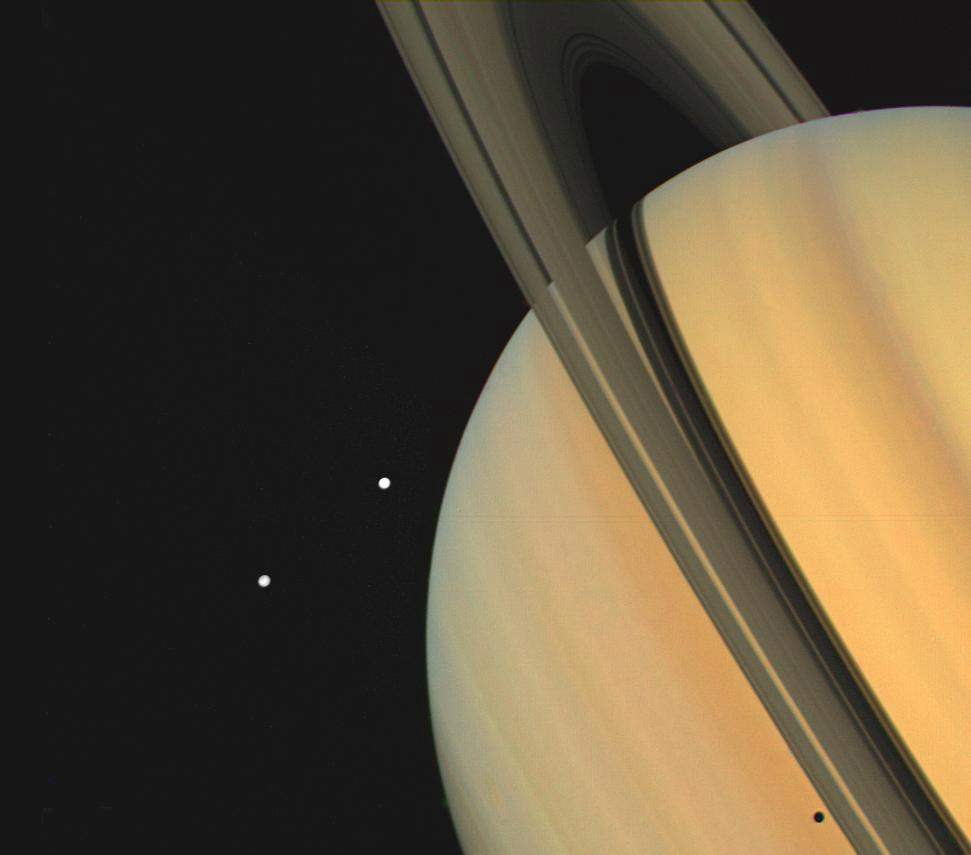
<h1>PIA00024:  Saturn With Tethys and Dione</h1><div class="PIA00024" lang="en" style="width:800px;text-align:left;margin:auto;background-color:#000;padding:10px;max-height:150px;overflow:auto;">Saturn and two of its moons, Tethys (above) and Dione, were photographed by Voyager 1 on November 3, 1980, from 13 million kilometers (8 million miles). The shadows of Saturn's three bright rings and Tethys are cast onto the cloud tops. The limb of the planet can be seen easily through the 3,500-kilometer-wide (2,170 mile) Cassini Division, which separates ring A from ring B. The view through the much narrower Encke Division, near the outer edge of ring A is less clear. Beyond the Encke Division (at left) is the faintest of Saturn's three bright rings, the C-ring or crepe ring, barely visible against the planet. The Voyager Project is managed by the Jet Propulsion Laboratory for NASA.<br /><br /><a href="http://photojournal.jpl.nasa.gov/catalog/PIA00024" onclick="window.open(this.href); return false;" title="Voir l'image 	 PIA00024:  Saturn With Tethys and Dione	  sur le site de la NASA">Voir l'image 	 PIA00024:  Saturn With Tethys and Dione	  sur le site de la NASA.</a></div>
PIA00024: Saturn With Tethys and Dione
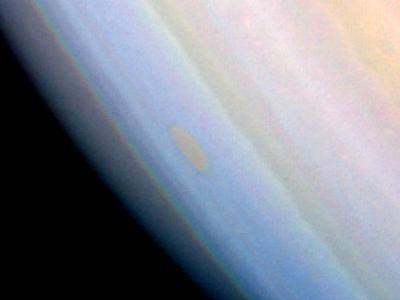
<h1>PIA00025:  Saturn - False Color of Southern Hemisphere</h1><div class="PIA00025" lang="en" style="width:400px;text-align:left;margin:auto;background-color:#000;padding:10px;max-height:150px;overflow:auto;">This false-color image of Saturn's southern hemisphere taken by NASA's Voyager 1 on Nov. 6, 1980, shows the unique red oval cloud feature located at 55 degrees south latitude. The photograph was taken by the spacecraft at a distance of 8,500,000 kilometers (5,300,000 miles) from Saturn. The difference in color between the red oval and surrounding bluish clouds indicates that material within the oval contains a substance that absorbs more blue and violet light than the bluish clouds. Voyager imaging team scientists first observed the oval in August 1980, and the feature has seemed to retain its appearance since its discovery. The Voyager Project is managed for NASA by the Jet Propulsion Laboratory, Pasadena, Calif.<br /><br /><a href="http://photojournal.jpl.nasa.gov/catalog/PIA00025" onclick="window.open(this.href); return false;" title="Voir l'image 	 PIA00025:  Saturn - False Color of Southern Hemisphere	  sur le site de la NASA">Voir l'image 	 PIA00025:  Saturn - False Color of Southern Hemisphere	  sur le site de la NASA.</a></div>
PIA00025: Saturn - False Color of Southern Hemisphere
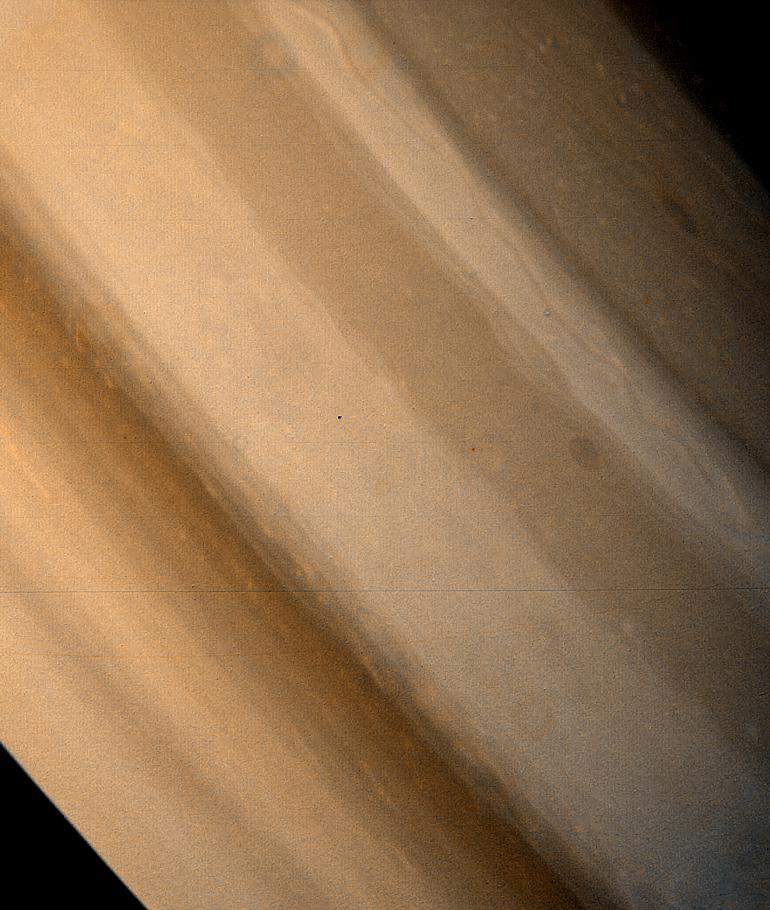
<h1>PIA00026:  Saturn - Brown Ovals in Northern Hemisphere</h1><div class="PIA00026" lang="en" style="width:770px;text-align:left;margin:auto;background-color:#000;padding:10px;max-height:150px;overflow:auto;">Two brown ovals, at right, some 10,000 kilometers (6,000 miles) across, were found at approximately 40` and 60` latitude in Saturn's northern hemisphere by Voyager l. The photo was taken on November 7, 1980, from a range of 7,500,000 kilometers (4,600,000 miles). The polar oval (upper right) has a structure similar to the Saturn red spot located in the southern polar latitudes. The Voyager Project is managed by the Jet Propulsion Laboratory for NASA.<br /><br /><a href="http://photojournal.jpl.nasa.gov/catalog/PIA00026" onclick="window.open(this.href); return false;" title="Voir l'image 	 PIA00026:  Saturn - Brown Ovals in Northern Hemisphere	  sur le site de la NASA">Voir l'image 	 PIA00026:  Saturn - Brown Ovals in Northern Hemisphere	  sur le site de la NASA.</a></div>
PIA00026: Saturn - Brown Ovals in Northern Hemisphere
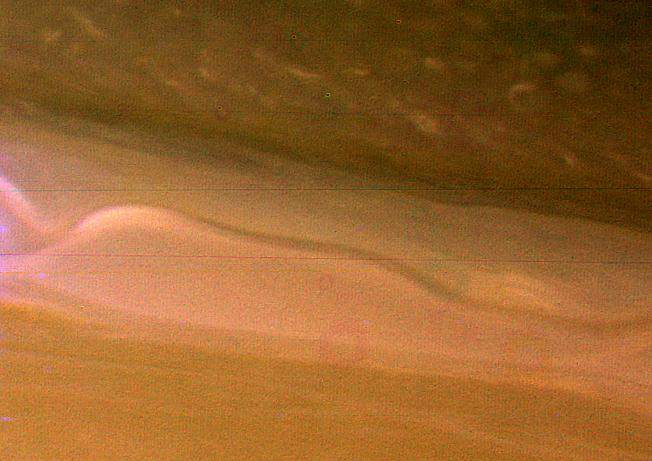
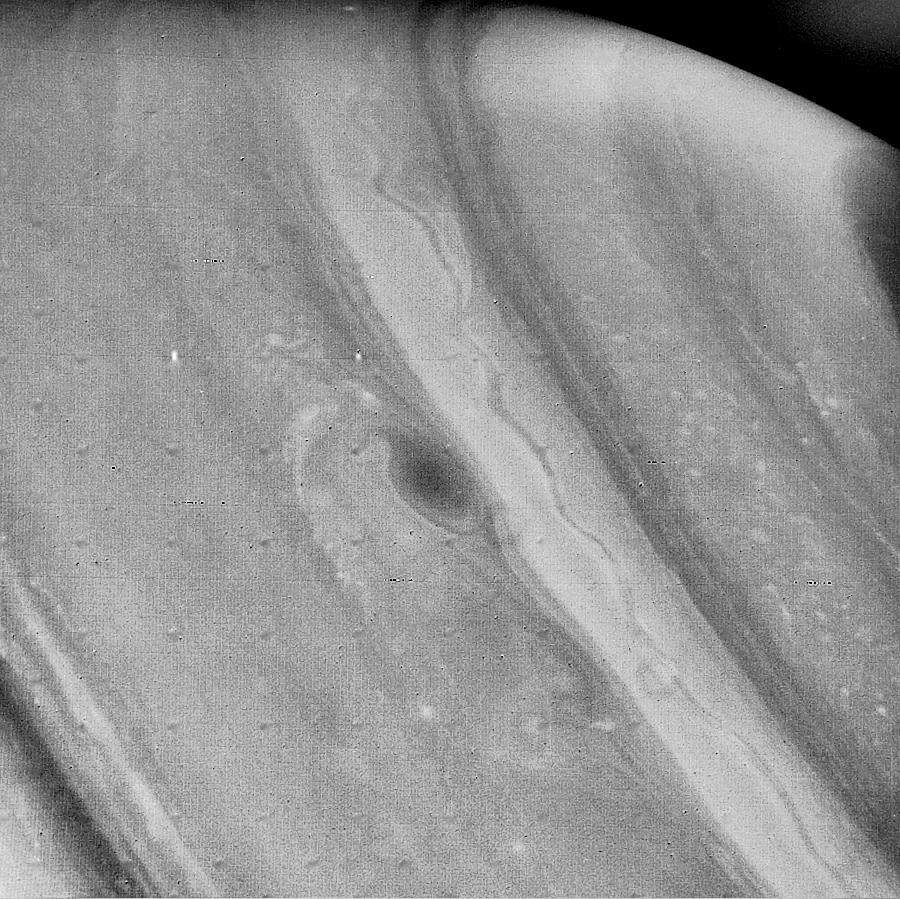
<h1>PIA00027:  Saturn - Ribbon-like Wave Structure in Atmosphere</h1><div class="PIA00027" lang="en" style="width:652px;text-align:left;margin:auto;background-color:#000;padding:10px;max-height:150px;overflow:auto;">A view of Saturn's clouds extending from 40` to 60` N latitude shows a ribbon-like wave structure in the south with small convective features marking a westward jet in the north. This image was obtained on November 10, 1980 when Voyager 1 was at a distance of 3,500,000 kilometers (2,200,000 miles) from Saturn. The smallest resolved features in this photograph are 65 kilometers (40 miles) in diameter. Images with similar resolution indicate that Saturn's circulation is somewhat different from Jupiter's. The maximum westward velocities seen on Saturn are located in the middle of the darker regions, while on Jupiter they are located at the poleward interface between belts and zones. The Voyager Project is managed by the Jet Propulsion Laboratory for NASA.<br /><br /><a href="http://photojournal.jpl.nasa.gov/catalog/PIA00027" onclick="window.open(this.href); return false;" title="Voir l'image 	 PIA00027:  Saturn - Ribbon-like Wave Structure in Atmosphere	  sur le site de la NASA">Voir l'image 	 PIA00027:  Saturn - Ribbon-like Wave Structure in Atmosphere	  sur le site de la NASA.</a></div>
PIA00027: Saturn - Ribbon-like Wave Structure in Atmosphere
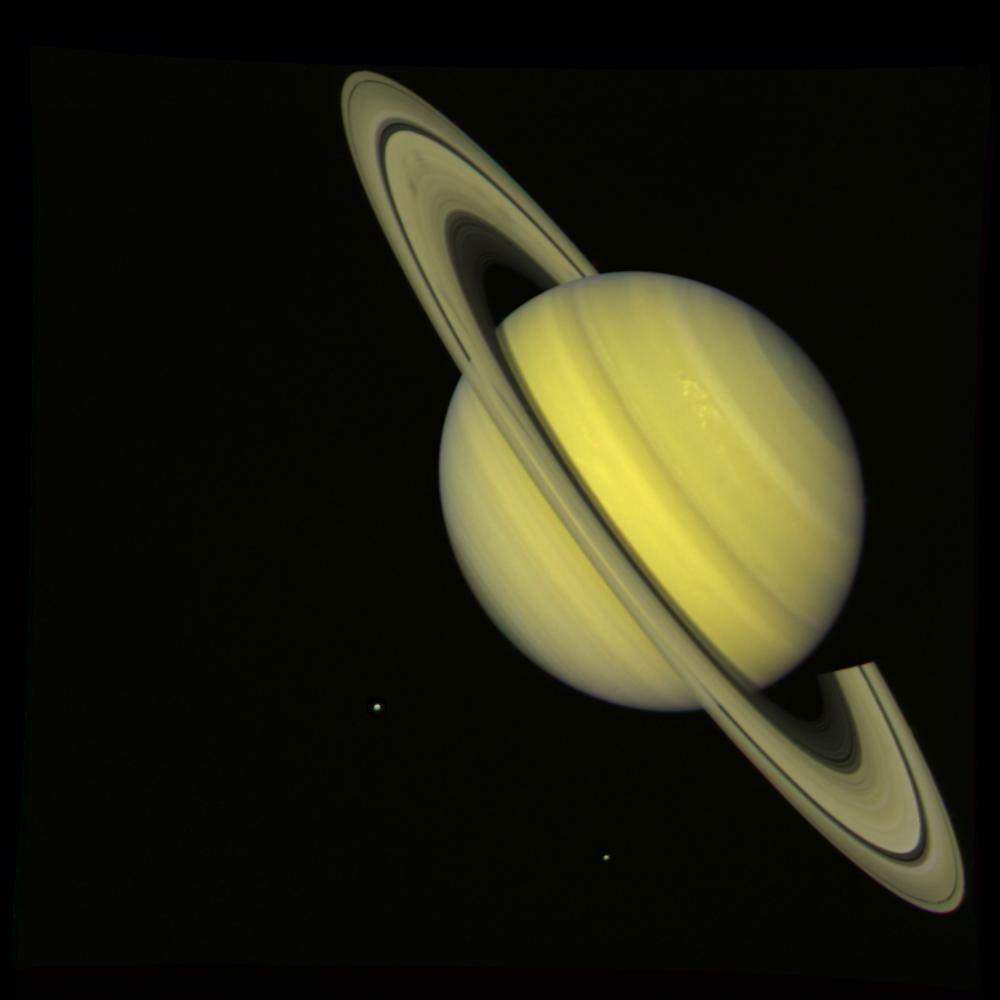
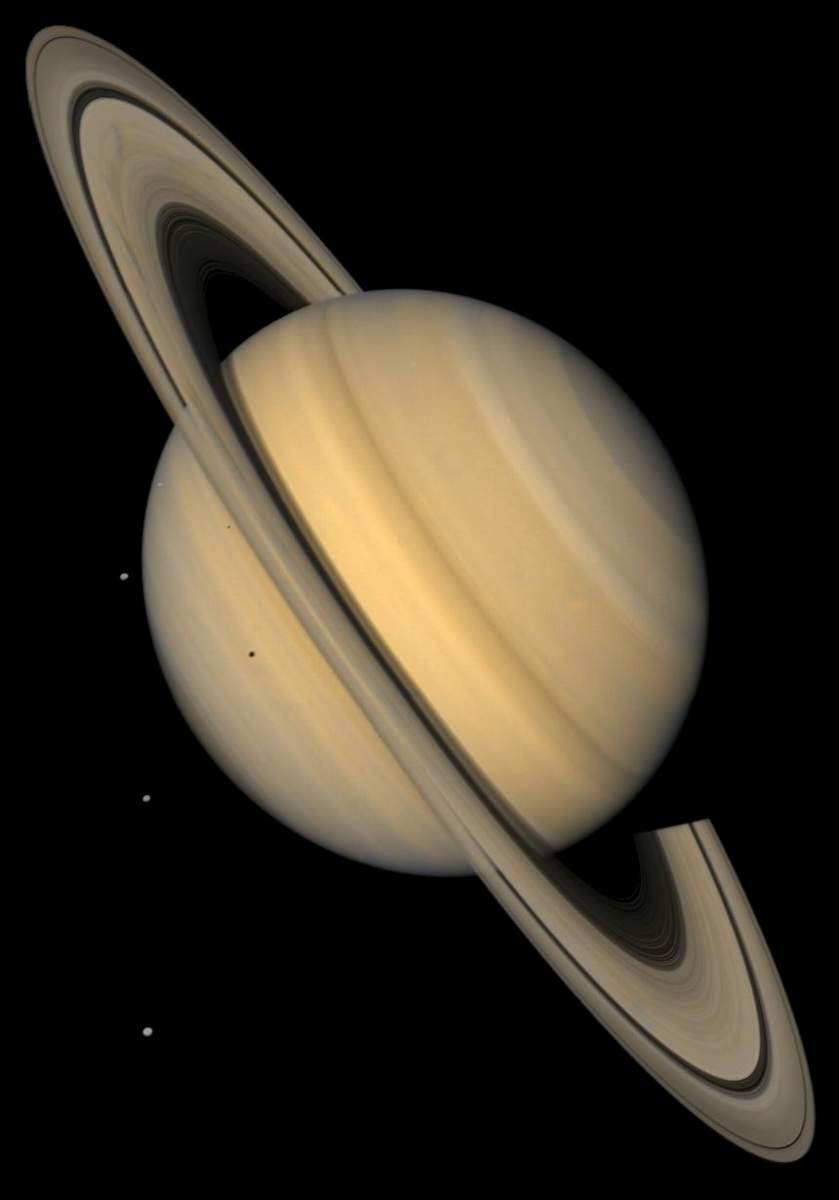
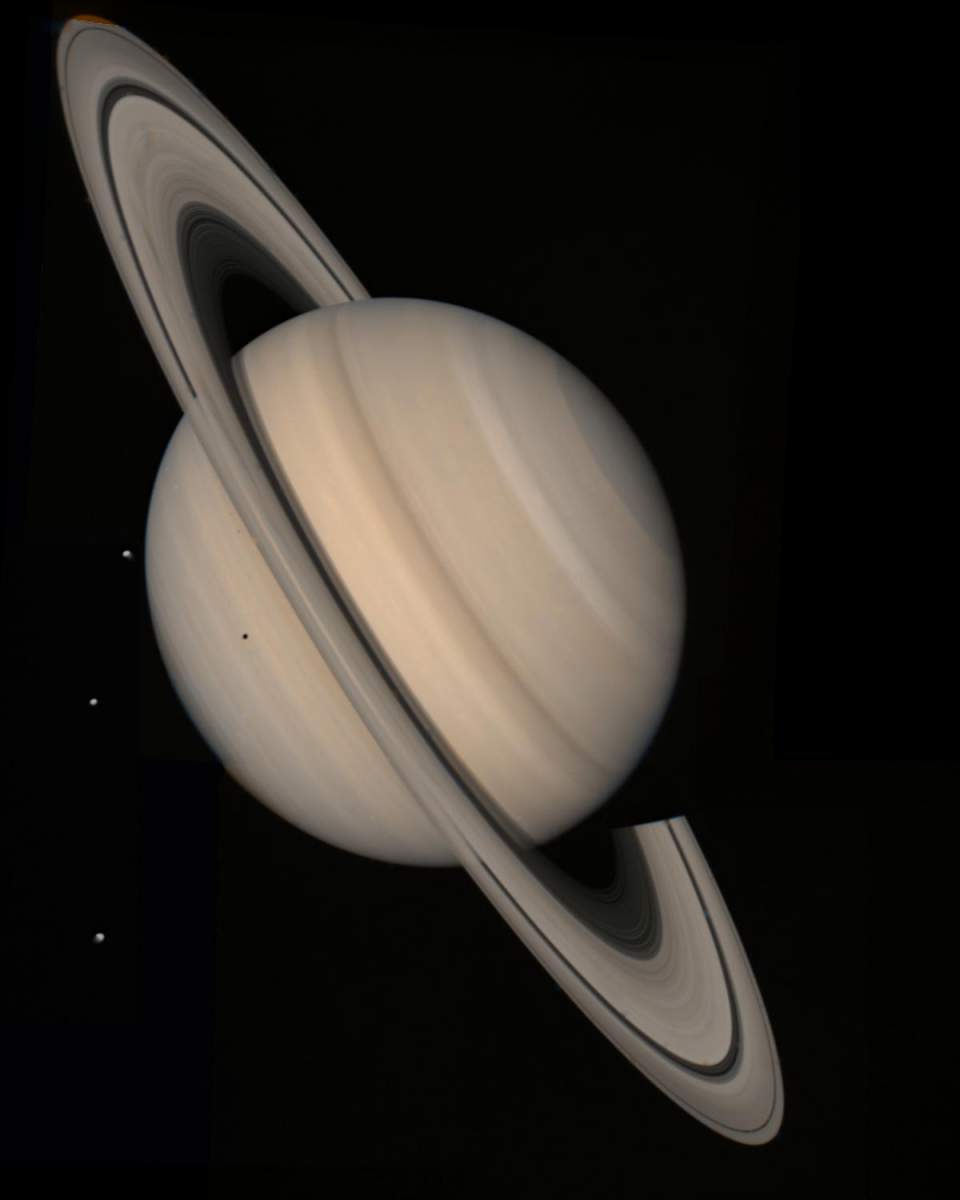
<h1>PIA00030:  Saturn With Rhea and Dione (true color)</h1><div class="PIA00030" lang="en" style="width:800px;text-align:left;margin:auto;background-color:#000;padding:10px;max-height:150px;overflow:auto;">NASA's Voyager 2 took this 'true color' photograph of Saturn on July 21, 1981, when the spacecraft was 33.9 million kilometers (21 million miles) from the planet. Two bright, presumably convective cloud patterns are visible in the mid-northern hemisphere and several dark spoke-like features can be seen in the broad B-ring (left of planet). The moons Rhea and Dione appear as blue dots to the south and southeast of Saturn, respectively. Voyager 2 made its closest approach to Saturn on Aug. 25, 1981. The Voyager project is managed for NASA by the Jet Propulsion Laboratory, Pasadena, Calif.<br /><br /><a href="http://photojournal.jpl.nasa.gov/catalog/PIA00030" onclick="window.open(this.href); return false;" title="Voir l'image 	 PIA00030:  Saturn With Rhea and Dione (true color)	  sur le site de la NASA">Voir l'image 	 PIA00030:  Saturn With Rhea and Dione (true color)	  sur le site de la NASA.</a></div>
PIA00030: Saturn With Rhea and Dione (true color)
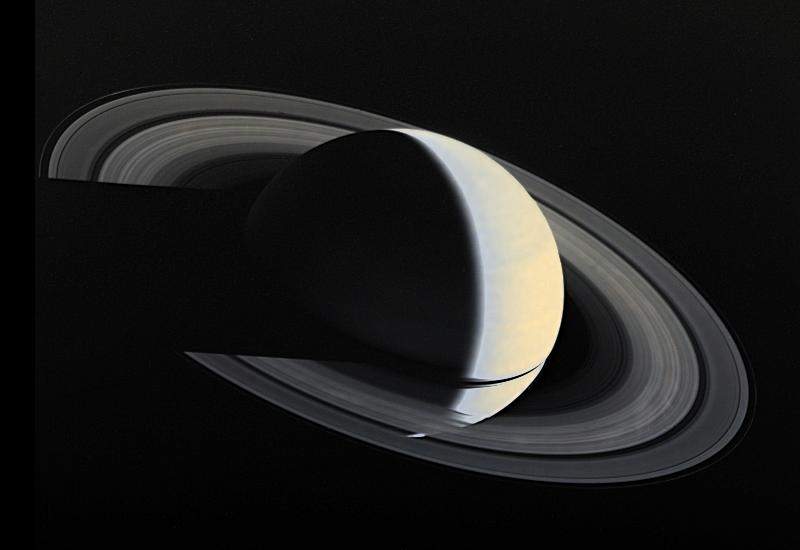
<h1>PIA00335:  Full-disk Color Image of Crescent Saturn with Rings and Ring Shadows</h1><div class="PIA00335" lang="en" style="width:800px;text-align:left;margin:auto;background-color:#000;padding:10px;max-height:150px;overflow:auto;">Voyager 1 image of Saturn and its ring taken Nov. 16, 1980 four days after closest approach to Saturn, from a distance of 5,300, 000 km (3,300,000 miles). This viewing geometry, which shows Saturn as a crescent, is never achieved from Earth. The Saturnian rings, like the cloud tops of Saturn itself, are visible because they reflect sunlight. The translucent nature of the rings is apparent where Saturn can be seen through parts of the rings. Other parts of the rings are so dense with orbiting ice particles that almost no sunlight shines through them and a shadow is cast onto the yellowish cloud tops of Saturn, which in turn, casts a shadow across the rings at right. The black strip within the rings is the Cassini Division, which contains much less orbiting ring material than elsewhere in the rings.<br /><br /><a href="http://photojournal.jpl.nasa.gov/catalog/PIA00335" onclick="window.open(this.href); return false;" title="Voir l'image 	 PIA00335:  Full-disk Color Image of Crescent Saturn with Rings and Ring Shadows	  sur le site de la NASA">Voir l'image 	 PIA00335:  Full-disk Color Image of Crescent Saturn with Rings and Ring Shadows	  sur le site de la NASA.</a></div>
PIA00335: Full-disk Color Image of Crescent Saturn with Rings and Ring Shadows
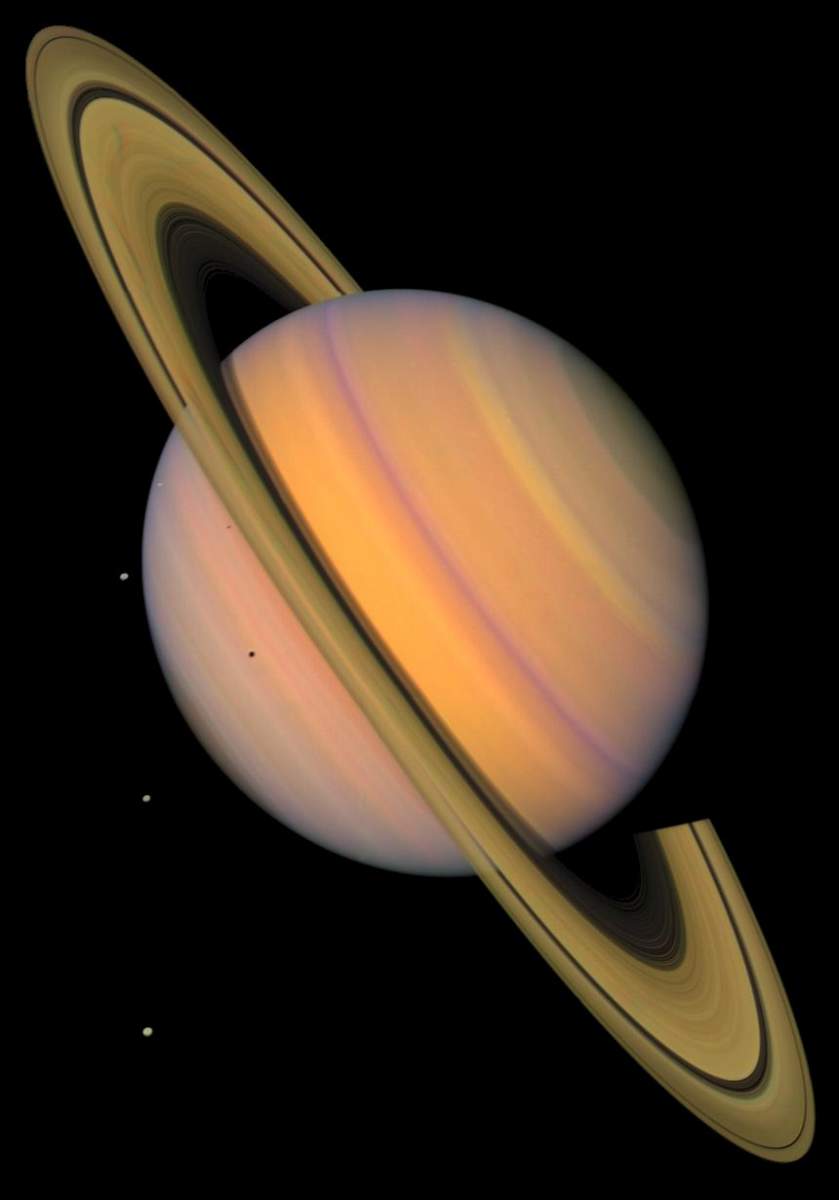
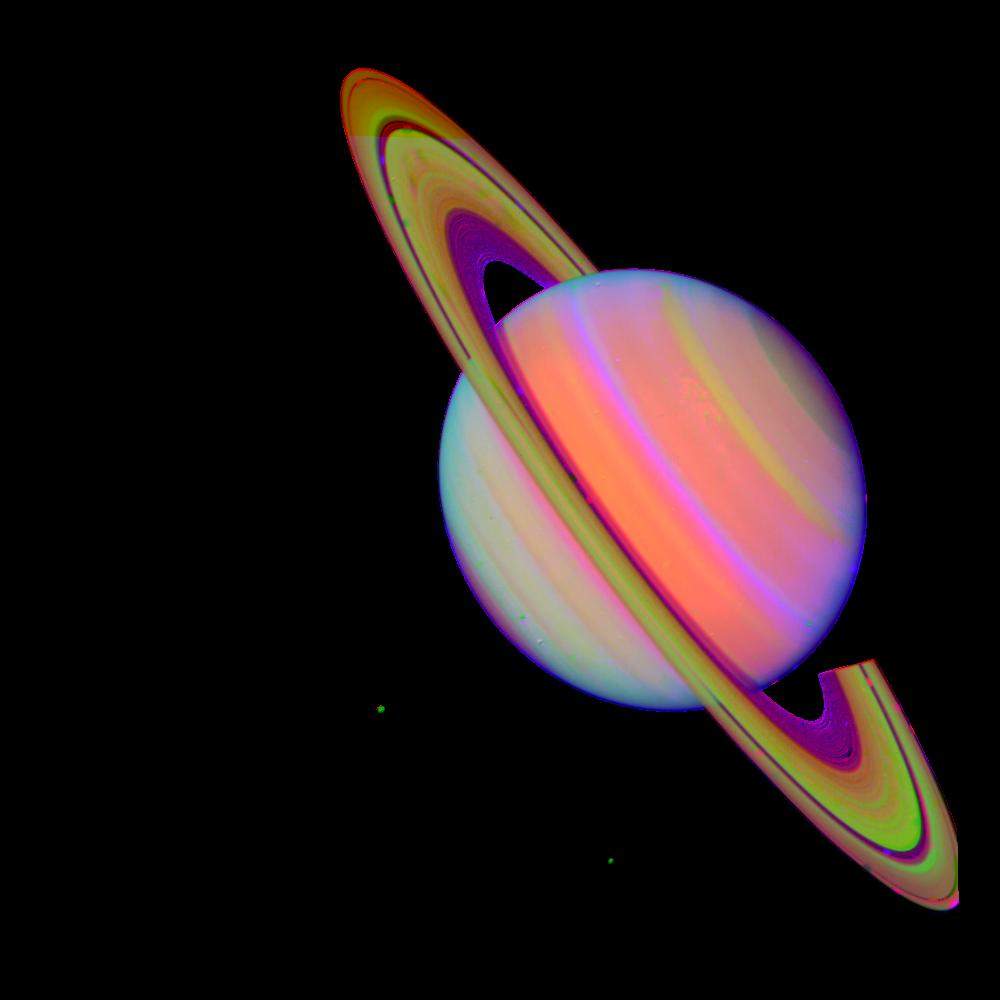
<h1>PIA00349:  Saturn and 4 Icy Moons, Enhanced Color</h1><div class="PIA00349" lang="en" style="width:800px;text-align:left;margin:auto;background-color:#000;padding:10px;max-height:150px;overflow:auto;">This enhanced-color picture shows Saturn, its rings, and four of its icy satellites. Three satellites (Tethys, Dione, and Rhea) are visible against the darkness of space, and another smaller satellite (Mimas) is visible against Saturn's cloud tops very near the left horizon and just below the rings. The dark shadows of Mimas and Tethys are also visible on Saturn's cloud tops, and the shadow of Saturn is seen across part of the rings. Saturn, second in size only to Jupiter in our Solar System, is 120,660 km (75,000 mi) in diameter at its equator (the ring plane) but, because of its rapid spin, Saturn is 10% smaller measured through its poles. Saturn's rings are composed mostly of ice particles ranging from microscopic dust to boulders in size. These particles orbit Saturn in a vast disk that is a mere 100 meters (330 feet) or so thick. The rings' thinness contrasts with their huge diameter--for instance 272,400 km (169,000 mi) for the outer part of the bright A ring, the outermost ring visible here. The pronounced concentric gap in the rings, the Cassini Division (named after its discoverer), is a 3500-km wide region (2200 mi, almost the width of the United States) that is much less populated with ring particles than the brighter B and A rings to either side of the gap. The rings also show some enigmatic radial structure ('spokes'), particularly at left. This image was synthesized from images taken in Voyager's orange, blue, and ultraviolet filters and was processed to create an exaggerated false color.<br /><br /><a href="http://photojournal.jpl.nasa.gov/catalog/PIA00349" onclick="window.open(this.href); return false;" title="Voir l'image 	 PIA00349:  Saturn and 4 Icy Moons, Enhanced Color	  sur le site de la NASA">Voir l'image 	 PIA00349:  Saturn and 4 Icy Moons, Enhanced Color	  sur le site de la NASA.</a></div>
PIA00349: Saturn and 4 Icy Moons, Enhanced Color
<h1>PIA00400:  Saturn and 4 Icy Moons in Natural Color</h1><div class="PIA00400" lang="en" style="width:800px;text-align:left;margin:auto;background-color:#000;padding:10px;max-height:150px;overflow:auto;"><p>This approximate natural-color image shows Saturn, its rings, and four of its icy satellites. Three satellites (Tethys, Dione, and Rhea) are visible against the darkness of space, and another smaller satellite (Mimas) is visible against Saturn's cloud tops very near the left horizon and just below the rings. The dark shadows of Mimas and Tethys are also visible on Saturn's cloud tops, and the shadow of Saturn is seen across part of the rings. Saturn, second in size only to Jupiter in our Solar System, is 120,660 km (75,000 mi) in diameter at its equator (the ring plane) but, because of its rapid spin, Saturn is 10% smaller measured through its poles. Saturn's rings are composed mostly of ice particles ranging from microscopic dust to boulders in size. These particles orbit Saturn in a vast disk that is a mere 100 meters (330 feet) or so thick. The rings' thinness contrasts with their huge diameter--for instance 272,400 km (169,000 mi) for the outer part of the bright A ring, the outermost ring visible here. The pronounced concentric gap in the rings, the Cassini Division (named after its discoverer), is a 3500-km wide region (2200 mi, almost the width of the United States) that is much less populated with ring particles than the brighter B and A rings to either side of the gap. The rings also show some enigmatic radial structure ('spokes'), particularly at left. This image was synthesized from images taken in Voyager's blue and violet filters and was processed to recreate an approximately natural color and contrast.</p><br /><br /><a href="http://photojournal.jpl.nasa.gov/catalog/PIA00400" onclick="window.open(this.href); return false;" title="Voir l'image 	 PIA00400:  Saturn and 4 Icy Moons in Natural Color	  sur le site de la NASA">Voir l'image 	 PIA00400:  Saturn and 4 Icy Moons in Natural Color	  sur le site de la NASA.</a></div>
PIA00400: Saturn and 4 Icy Moons in Natural Color
<h1>PIA01143:  Saturn With Rhea and Dione (false color)</h1><div class="PIA01143" lang="en" style="width:800px;text-align:left;margin:auto;background-color:#000;padding:10px;max-height:150px;overflow:auto;">NASA's Voyager 2 took this 'false color' photograph of Saturn on July 21, 1981, when the spacecraft was 33.9 million kilometers (21 million miles) from the planet. Two bright, presumably convective cloud patterns are visible in the mid-northern hemisphere and several dark spoke-like features can be seen in the broad B-ring (left of planet). The moons Rhea and Dione appear as blue dots to the south and southeast of Saturn, respectively. Voyager 2 made its closest approach to Saturn on Aug. 25, 1981. The Voyager project is managed for NASA by the Jet Propulsion Laboratory, Pasadena, California<br /><br /><a href="http://photojournal.jpl.nasa.gov/catalog/PIA01143" onclick="window.open(this.href); return false;" title="Voir l'image 	 PIA01143:  Saturn With Rhea and Dione (false color)	  sur le site de la NASA">Voir l'image 	 PIA01143:  Saturn With Rhea and Dione (false color)	  sur le site de la NASA.</a></div>
PIA01143: Saturn With Rhea and Dione (false color)
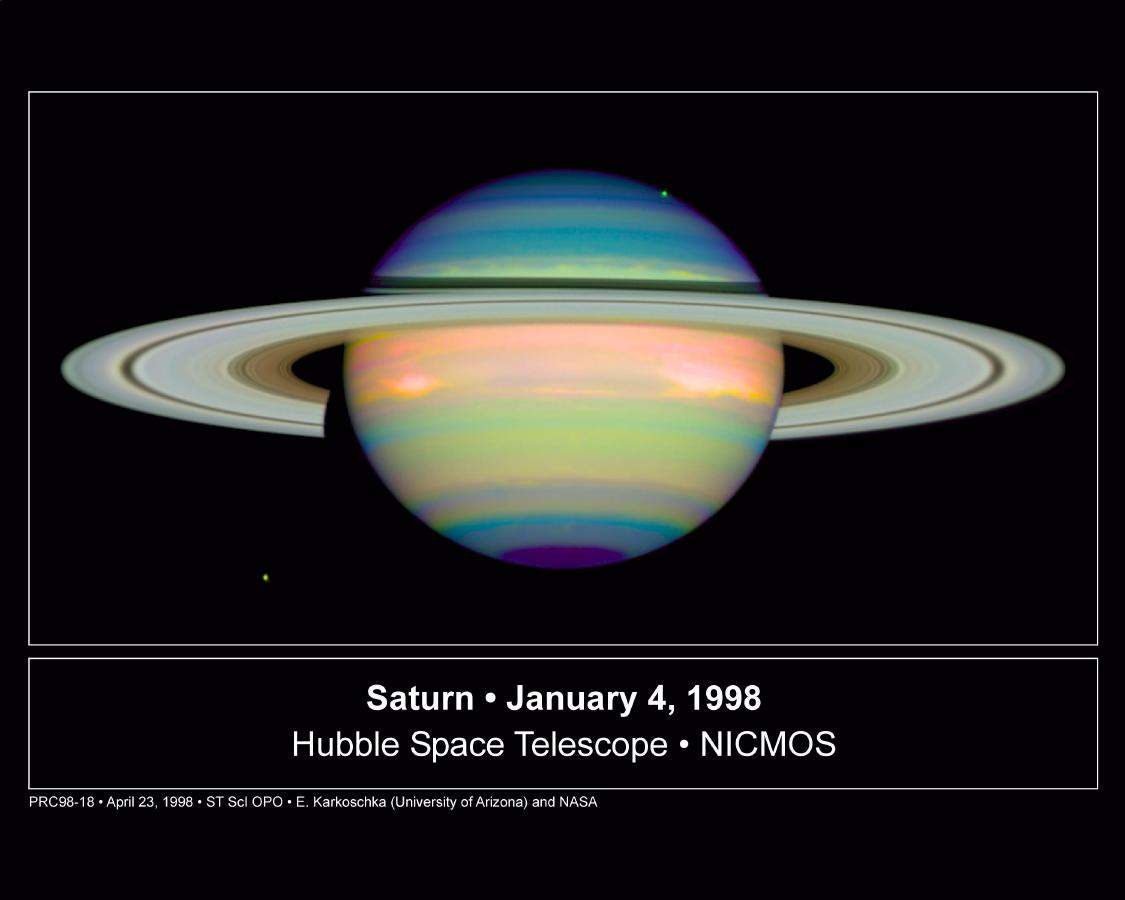
<h1>PIA01268:  An Infrared View of Saturn</h1><div class="PIA01268" lang="en" style="width:800px;text-align:left;margin:auto;background-color:#000;padding:10px;max-height:150px;overflow:auto;"><p>In honor of NASA Hubble Space Telescope's eighth anniversary, we have gift wrapped Saturn in vivid colors. Actually, this image is courtesy of the new Near Infrared Camera and Multi-Object Spectrometer (NICMOS), which has taken its first peek at Saturn. The false-color image - taken Jan. 4, 1998 - shows the planet's reflected infrared light. This view provides detailed information on the clouds and hazes in Saturn's atmosphere.<p>The blue colors indicate a clear atmosphere down to a main cloud layer. Different shadings of blue indicate variations in the cloud particles, in size or chemical composition. The cloud particles are believed to be ammonia ice crystals. Most of the northern hemisphere that is visible above the rings is relatively clear. The dark region around the south pole at the bottom indicates a big hole in the main cloud layer.<p>The green and yellow colors indicate a haze above the main cloud layer. The haze is thin where the colors are green but thick where they are yellow. Most of the southern hemisphere (the lower part of Saturn) is quite hazy. These layers are aligned with latitude lines, due to Saturn's east-west winds.<p>The red and orange colors indicate clouds reaching up high into the atmosphere. Red clouds are even higher than orange clouds. The densest regions of two storms near Saturn's equator appear white. On Earth, the storms with the highest clouds are also found in tropical latitudes. The smaller storm on the left is about as large as the Earth, and larger storms have been recorded on Saturn in 1990 and 1994.<p>The rings, made up of chunks of ice, are as white as images of ice taken in visible light. However, in the infrared, water absorption causes various colorations. The most obvious is the brown color of the innermost ring. The rings cast their shadow onto Saturn. The bright line seen within this shadow is sunlight shining through the Cassini Division, the separation between the two bright rings. It is best observed on the left side, just above the rings. This view is possible due to a rare geometry during the observation. The next time this observable from Earth will be in 2006. An accurate investigation of the ring's shadow also shows sunlight shining through the Encke Gap, a thin division very close to the outer edge of the ring system.<p>Two of Saturn's satellites were recorded, Dione on the lower left and Tethys on the upper right. Tethys is just ending its transit across the disk of Saturn. They appear in different colors, yellow and green, indicating different conditions on their icy surfaces.<p>Wavelengths: A color image consists of three exposures (or three film layers). For visible true-color images, the wavelengths of these three exposures are 0.4, 0.5, and 0.6 micrometers for blue, green, and red light, respectively. This Saturn image was taken at longer infrared wavelengths of 1.0, 1.8, and 2.1 micrometers, displayed as blue, green, and red. Reflected sunlight is seen at all these wavelengths, since Saturn's own heat glows only at wavelengths above 4 micrometers.<p>The Wide Field/Planetary Camera 2 was developed by the Jet Propulsion Laboratory and managed by the Goddard Space Flight Center for NASA's Office of Space Science.<p>This image and other images and data received from the Hubble Space Telescope are posted on the World Wide Web on the Space Telescope Science Institute home page at URL <a href="http://oposite.stsci.edu/" class="external free" target="wpext">http://oposite.stsci.edu/</a>.<br /><br /><a href="http://photojournal.jpl.nasa.gov/catalog/PIA01268" onclick="window.open(this.href); return false;" title="Voir l'image 	 PIA01268:  An Infrared View of Saturn	  sur le site de la NASA">Voir l'image 	 PIA01268:  An Infrared View of Saturn	  sur le site de la NASA.</a></div>
PIA01268: An Infrared View of Saturn
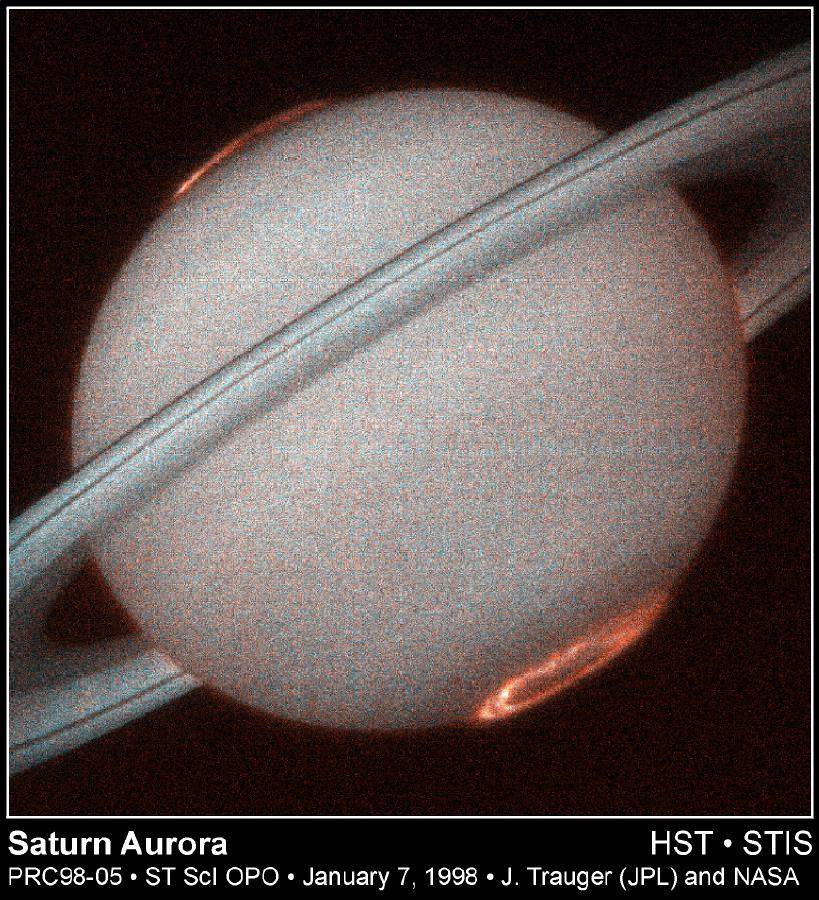
<h1>PIA01269:  Hubble Provides Clear Images of Saturn's Aurora</h1><div class="PIA01269" lang="en" style="width:800px;text-align:left;margin:auto;background-color:#000;padding:10px;max-height:150px;overflow:auto;"><p>This is the first image of Saturn's ultraviolet aurora taken by the Space Telescope Imaging Spectrograph (STIS) on board the Hubble Space Telescope in October 1997, when Saturn was a distance of 810 million miles (1.3 billion kilometers) from Earth. The new instrument, used as a camera, provides more than ten times the sensitivity of previous Hubble instruments in the ultraviolet. STIS images reveal exquisite detail never before seen in the spectacular auroral curtains of light that encircle Saturn's north and south poles and rise more than a thousand miles above the cloud tops.<p>Saturn's auroral displays are caused by an energetic wind from the Sun that sweeps over the planet, much like the Earths aurora that is occasionally seen in the nighttime sky and similar to the phenomenon that causes fluorescent lamps to glow. But unlike the Earth, Saturn's aurora is only seen in ultraviolet light that is invisible from the Earths surface, hence the aurora can only be observed from space. New Hubble images reveal ripples and overall patterns that evolve slowly, appearing generally fixed in our view and independent of planet rotation. At the same time, the curtains show local brightening that often follow the rotation of the planet and exhibit rapid variations on time scales of minutes. These variations and regularities indicate that the aurora is primarily shaped and powered by a continual tug-of-war between Saturn's magnetic field and the flow of charged particles from the Sun.<p>Study of the aurora on Saturn had its beginnings just seventeen years ago. The Pioneer 11 spacecraft observed a far-ultraviolet brightening on Saturn's poles in 1979. The Saturn flybys of the Voyager 1 and 2 spacecraft in the early 1980s provided a basic description of the aurora and mapped for the first time planets enormous magnetic field that guides energetic electrons into the atmosphere near the north and south poles.<p>The first images of Saturn's aurora were provided in 1994-5 by the Hubble Space Telescopes Wide Field and Planetary Camera (WFPC2). Much greater ultraviolet sensitivity of the new STIS instrument allows the workings of Saturn's magnetosphere and upper atmosphere to be studied in much greater detail. These Hubble aurora investigations provide a framework that will ultimately complement the in situ measurements of Saturn's magnetic field and charged particles by NASA/ ESA's Cassini spacecraft, now en route to its rendezvous with Saturn early in the next decade.<p>Two STIS imaging modes have been used to discriminate between ultraviolet emissions predominantly from hydrogen atoms (shown in red) and emissions due to molecular hydrogen (shown in blue). Hence the bright red aurora features are dominated by atomic hydrogen, while the white traces within them map the more tightly confined regions of molecular hydrogen emissions. The southern aurora is seen at lower right, the northern at upper left.<p>The Wide Field/Planetary Camera 2 was developed by the Jet Propulsion Laboratory and managed by the Goddard Space Flight Center for NASA's Office of Space Science.<p>This image and other images and data received from the Hubble Space Telescope are posted on the World Wide Web on the Space Telescope Science Institute home page at URL <a href="http://oposite.stsci.edu/" class="external free" target="wpext">http://oposite.stsci.edu/</a>.<br /><br /><a href="http://photojournal.jpl.nasa.gov/catalog/PIA01269" onclick="window.open(this.href); return false;" title="Voir l'image 	 PIA01269:  Hubble Provides Clear Images of Saturn's Aurora	  sur le site de la NASA">Voir l'image 	 PIA01269:  Hubble Provides Clear Images of Saturn's Aurora	  sur le site de la NASA.</a></div>
PIA01269: Hubble Provides Clear Images of Saturn's Aurora
<h1>PIA01270:  Sunset on Saturn's Rings</h1><div class="PIA01270" lang="en" style="width:800px;text-align:left;margin:auto;background-color:#000;padding:10px;max-height:150px;overflow:auto;"><p>This is a rare view of Saturn's rings seen just after the Sun has set below the ring plane, taken with the Hubble Space Telescope on Nov. 21, 1995.<p>This perspective is unusual because the Earth is slightly above (2.7 degrees latitude) Saturn's rings and the Sun is below them. Normally we see the rings fully illuminated by the Sun.<p>The photograph shows three bright ring features: the F Ring, the Cassini Division, and the C Ring (moving from the outer rings to the inner). The low concentration of material in these rings allows light from the Sun to shine through them. The A and B rings are much denser, which limits the amount of light that penetrates through them. Instead, they are faintly visible because they reflect light from Saturn's disk.<p>Scientists believe that the F Ring is slightly warped because it disappears part way around on the right (West) side. Hubble's high resolution shows the that A Ring's shadow obscures part of the F ring (right).<p>The image was assembled from 20 exposures taken with Wide Field Planetary Camera-2 over 8 hours.<p>The Wide Field/Planetary Camera 2 was developed by the Jet Propulsion Laboratory and managed by the Goddard Space Flight Center for NASA's Office of Space Science.<p>This image and other images and data received from the Hubble Space Telescope are posted on the World Wide Web on the Space Telescope Science Institute home page at URL <a href="http://oposite.stsci.edu/" class="external free" target="wpext">http://oposite.stsci.edu/</a>.<br /><br /><a href="http://photojournal.jpl.nasa.gov/catalog/PIA01270" onclick="window.open(this.href); return false;" title="Voir l'image 	 PIA01270:  Sunset on Saturn's Rings	  sur le site de la NASA">Voir l'image 	 PIA01270:  Sunset on Saturn's Rings	  sur le site de la NASA.</a></div>
PIA01270: Sunset on Saturn's Rings
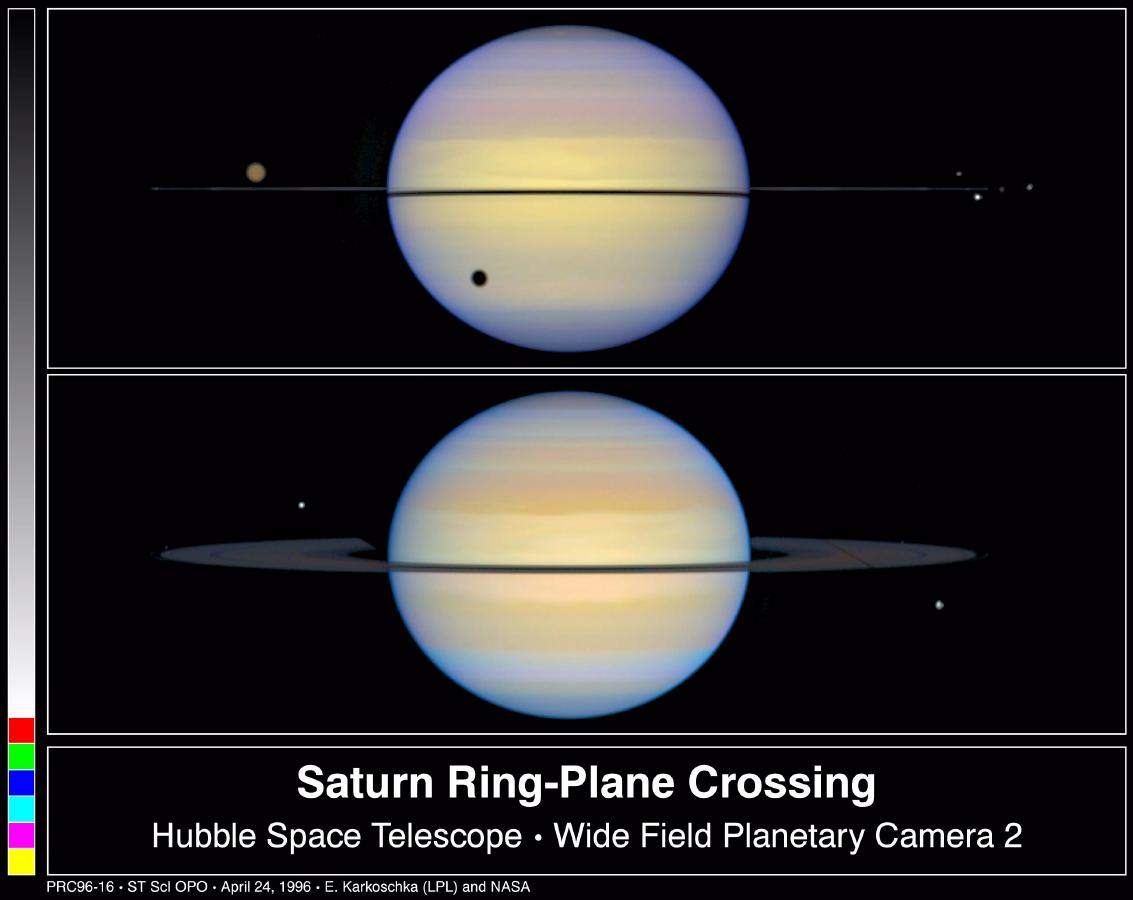
<h1>PIA01272:  Edge-on View of Saturn's Rings</h1><div class="PIA01272" lang="en" style="width:800px;text-align:left;margin:auto;background-color:#000;padding:10px;max-height:150px;overflow:auto;"><p>TOP - This is a NASA Hubble Space Telescope snapshot of Saturn with its rings barely visible. Normally, astronomers see Saturn with its rings tilted. Earth was almost in the plane of Saturn's rings, thus the rings appear edge-on.<p>In this view, Saturn's largest moon, Titan, is casting a shadow on Saturn. Titan's atmosphere is a dark brown haze. The other moons appear white because of their bright, icy surfaces. Four moons - from left to right, Mimas, Tethys, Janus, and Enceladus - are clustered around the edge of Saturn's rings on the right. Two other moons appear in front of the ring plane. Prometheus is on the right edge; Pandora, on the left. The rings also are casting a shadow on Saturn because the Sun was above the ring plane.<p>BOTTOM - This photograph shows Saturn with its rings slightly tilted. The moon called Dione, on the lower right, is casting a long, thin shadow across the whole ring system due to the setting Sun on the ring plane. The moon on the upper left of Saturn is Tethys.<p>Astronomers also are studying the unusual appearance of Saturn's rings. The bottom image displays a faint, narrow ring, the F-ring just outside the main ring, which normally is invisible from Earth. Close to the edge of Saturn's disk, the front section of rings seem brighter and more yellow than the back due to the additional lumination by yellowish Saturn.<p>The color images were assembled from separate exposures taken August 6 (top) and November 17 (bottom), 1995 with the Wide Field Planetary Camera-2.<p>The Wide Field/Planetary Camera 2 was developed by the Jet Propulsion Laboratory and managed by the Goddard Space Flight Center for NASA's Office of Space Science.<p>This image and other images and data received from the Hubble Space Telescope are posted on the World Wide Web on the Space Telescope Science Institute home page at URL <a href="http://oposite.stsci.edu/" class="external free" target="wpext">http://oposite.stsci.edu/</a>.<br /><br /><a href="http://photojournal.jpl.nasa.gov/catalog/PIA01272" onclick="window.open(this.href); return false;" title="Voir l'image 	 PIA01272:  Edge-on View of Saturn's Rings	  sur le site de la NASA">Voir l'image 	 PIA01272:  Edge-on View of Saturn's Rings	  sur le site de la NASA.</a></div>
PIA01272: Edge-on View of Saturn's Rings
<h1>PIA01273:  Hubble again views Saturn's Rings Edge-on</h1><div class="PIA01273" lang="en" style="width:800px;text-align:left;margin:auto;background-color:#000;padding:10px;max-height:150px;overflow:auto;"><p>Saturn's magnificent ring system is seen tilted edge-on -- for the second time this year -- in this NASA Hubble Space Telescope picture taken on August 10, 1995, when the planet was 895 million miles (1,440 million kilometers) away. Hubble snapped the image as Earth sped back across Saturn's ring plane to the sunlit side of the rings. Last May 22, Earth dipped below the ring plane, giving observers a brief look at the backlit side of the rings. Ring-plane crossing events occur approximately every 15 years. Earthbound observers won't have as good a view until the year 2038. Several of Saturn's icy moons are visible as tiny starlike objects in or near the ring plane. They are from left to right, Enceladus, Tethys, Dione and Mimas. "The Hubble data shows numerous faint satellites close to the bright rings, but it will take a couple of months to precisely identify them," according to Steve Larson (University of Arizona). During the May ring plane crossing, Hubble detected two, and possibly four, new moons orbiting Saturn. These new observations also provide a better view of the faint E ring, "to help determine the size of particles and whether they will pose a collision hazard to the Cassini spacecraft," said Larson. The picture was taken with Hubble's Wide Field Planetary Camera 2 in wide field mode. This image is a composite view, where a long exposure of the faint rings has been combined with a shorter exposure of Saturn's disk to bring out more detail. When viewed edge-on, the rings are so dim they almost disappear because they are very thin -- probably less than a mile thick.<p>The Wide Field/Planetary Camera 2 was developed by the Jet Propulsion Laboratory and managed by the Goddard Space Flight Center for NASA's Office of Space Science.<p>This image and other images and data received from the Hubble Space Telescope are posted on the World Wide Web on the Space Telescope Science Institute home page at URL <a href="http://oposite.stsci.edu/" class="external free" target="wpext">http://oposite.stsci.edu/</a>.<br /><br /><a href="http://photojournal.jpl.nasa.gov/catalog/PIA01273" onclick="window.open(this.href); return false;" title="Voir l'image 	 PIA01273:  Hubble again views Saturn's Rings Edge-on	  sur le site de la NASA">Voir l'image 	 PIA01273:  Hubble again views Saturn's Rings Edge-on	  sur le site de la NASA.</a></div>
PIA01273: Hubble again views Saturn's Rings Edge-on
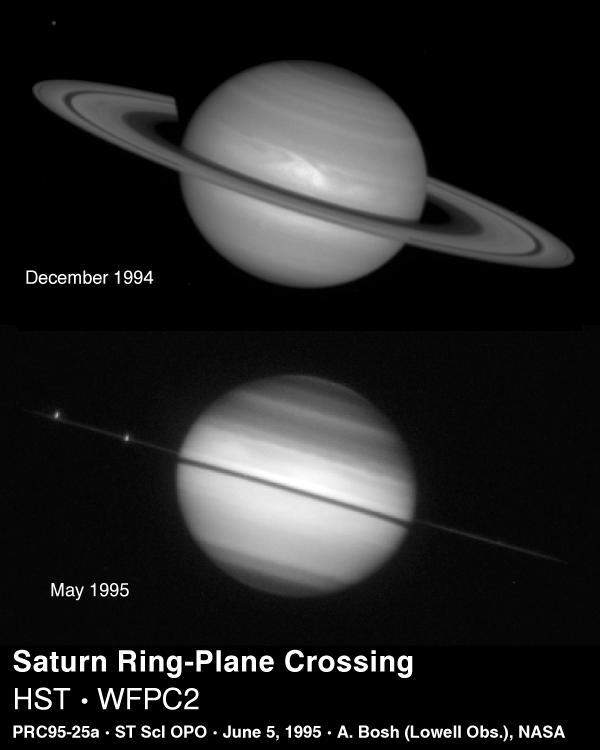
<h1>PIA01275:  Saturn's Rings Edge-on</h1><div class="PIA01275" lang="en" style="width:600px;text-align:left;margin:auto;background-color:#000;padding:10px;max-height:150px;overflow:auto;"><p>In one of nature's most dramatic examples of "now-you see-them, now-you-don't," NASA's Hubble Space Telescope captured Saturn on May 22, 1995 as the planet's magnificent ring system turned edge-on. This ring-plane crossing occurs approximately every 15 years when the Earth passes through Saturn's ring plane.<p>For comparison, the top picture was taken by Hubble on December 1, 1994 and shows the rings in a more familiar configuration for Earth observers.<p>The bottom picture was taken shortly before the ring plane crossing. The rings do not disappear completely because the edge of the rings reflects sunlight. The dark band across the middle of Saturn is the shadow of the rings cast on the planet (the Sun is almost 3 degrees above the ring plane.) The bright stripe directly above the ring shadow is caused by sunlight reflected off the rings onto Saturn's atmosphere. Two of Saturn's icy moons are visible as tiny starlike objects in or near the ring plane. They are, from left to right, Tethys (slightly above the ring plane) and Dione.<p>This observation will be used to determine the time of ring-plane crossing and the thickness of the main rings and to search for as yet undiscovered satellites. Knowledge of the exact time of ring-plane crossing will lead to an improved determination of the rate at which Saturn "wobbles" about its axis (polar precession).<p>Both pictures were taken with Hubble's Wide Field Planetary Camera 2. The top image was taken in visible light. Saturn's disk appears different in the bottom image because a narrowband filter (which only lets through light that is not absorbed by methane gas in Saturn's atmosphere) was used to reduce the bright glare of the planet. Though Saturn is approximately 900 million miles away, Hubble can see details as small as 450 miles across.<p>The Wide Field/Planetary Camera 2 was developed by the Jet Propulsion Laboratory and managed by the Goddard Space Flight Center for NASA's Office of Space Science.<p>This image and other images and data received from the Hubble Space Telescope are posted on the World Wide Web on the Space Telescope Science Institute home page at URL <a href="http://oposite.stsci.edu/" class="external free" target="wpext">http://oposite.stsci.edu/</a>.<br /><br /><a href="http://photojournal.jpl.nasa.gov/catalog/PIA01275" onclick="window.open(this.href); return false;" title="Voir l'image 	 PIA01275:  Saturn's Rings Edge-on	  sur le site de la NASA">Voir l'image 	 PIA01275:  Saturn's Rings Edge-on	  sur le site de la NASA.</a></div>
PIA01275: Saturn's Rings Edge-on
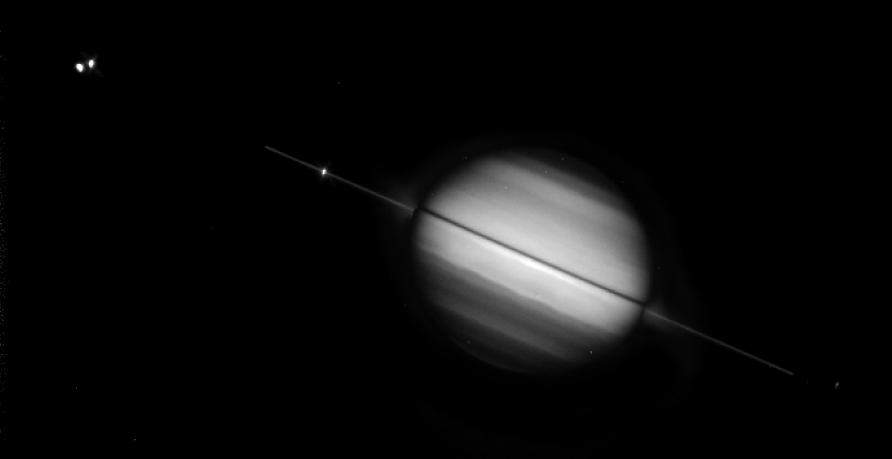
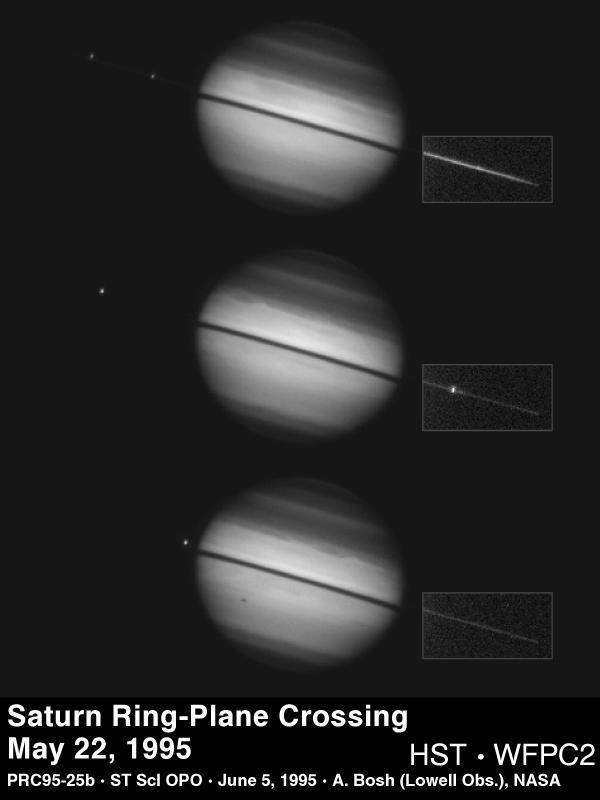
<h1>PIA01276:  Hubble Views Saturn Ring-Plane Crossing</h1><div class="PIA01276" lang="en" style="width:600px;text-align:left;margin:auto;background-color:#000;padding:10px;max-height:150px;overflow:auto;"><p>This sequence of images from NASA's Hubble Space Telescope documents a rare astronomical alignment—Saturn's magnificent ring system turned edge-on. This occurs when the Earth passes through Saturn's ring plane, as it does approximately every 15 years.<p>These pictures were taken with Hubble's Wide Field Planetary Camera 2 on 22 May 1995, when Saturn was at a distance of 919 million miles (1.5 billion kilometers) from Earth. At Saturn, Hubble can see details as small as 450 miles (725 km) across. In each image, the dark band across Saturn is the ring shadow cast by the Sun which is still 2.7 degrees above Saturn's ring plane. The box around the western portion of the rings (to the right of Saturn) in each image indicates the area in which the faint light from the rings has been multiplied through image processing (by a factor of 25) to make the rings more visible.<p>[Top] -<p>This image was taken while the Earth was above the lit face of the rings. The moons Tethys and Dione are visible to the east (left) of Saturn; Janus is the bright spot near the center of the ring portion in the box, and Pandora is faintly visible just inside the left edge of this box. Saturn's atmosphere shows remarkable detail: multiple banding in both the northern and southern hemispheres, wispy structure at the north edge of the equatorial zone, and a bright area above the ring shadow that is caused by sunlight scattered off the rings onto the atmosphere. There is evidence of a faint polar haze over the north pole of Saturn and a fainter haze over the south.<p>[Center] -<p>This image was taken close to the time of ring-plane crossing. The rings are 75% fainter than in the top image, though they do not disappear completely because the vertical face of the rings still reflects sunlight when the rings are edge-on. Rhea is visible to the east of Saturn, Enceladus is the bright satellite in the rings to the west, and Janus is the fainter blip to its right. Pandora is just to the left of Enceladus, but is not visible because Enceladus is too bright. An oval-shaped atmospheric feature has just rotated into view (near the eastern limb, at the northern edge of the equatorial zone), and appears to be a local circulation pattern that is not penetrated by the bright clouds that are deflected around it.<p>[Bottom] -<p>This image was taken approximately 96 minutes (one Hubble orbit) after the center image. The rings are 10% brighter than they were in that image. Rhea is visible just off the eastern limb of Saturn, and casts a shadow on the south face of Saturn. During this exposure, the Earth and Sun were on opposite sides of Saturn's ring plane (they remain in this configuration until 10 August 1995). The atmospheric circulation pattern has rotated to just past the center of the planet's disk, and is followed by more wispy structure in the bright band of clouds, reminiscent of the structure seen during the Saturn storm observed in 1990.<p>These images will be used to determine the time of ring-plane crossing and the thickness of the main rings and to search for as yet undiscovered satellites. Knowledge of the exact time of ring-plane crossing will lead to an improved determination of the rate at which Saturn "wobbles" about its axis (polar precession).<p>Technical Notes Each of these images is a 7-second exposure at 8922 Angstroms in a methane absorption band. North is up and east is to the left.<p>The Wide Field/Planetary Camera 2 was developed by the Jet Propulsion Laboratory and managed by the Goddard Space Flight Center for NASA's Office of Space Science.<p>This image and other images and data received from the Hubble Space Telescope are posted on the World Wide Web on the Space Telescope Science Institute home page at URL <a href="http://oposite.stsci.edu/" class="external free" target="wpext">http://oposite.stsci.edu/</a>.<br /><br /><a href="http://photojournal.jpl.nasa.gov/catalog/PIA01276" onclick="window.open(this.href); return false;" title="Voir l'image 	 PIA01276:  Hubble Views Saturn Ring-Plane Crossing	  sur le site de la NASA">Voir l'image 	 PIA01276:  Hubble Views Saturn Ring-Plane Crossing	  sur le site de la NASA.</a></div>
PIA01276: Hubble Views Saturn Ring-Plane Crossing
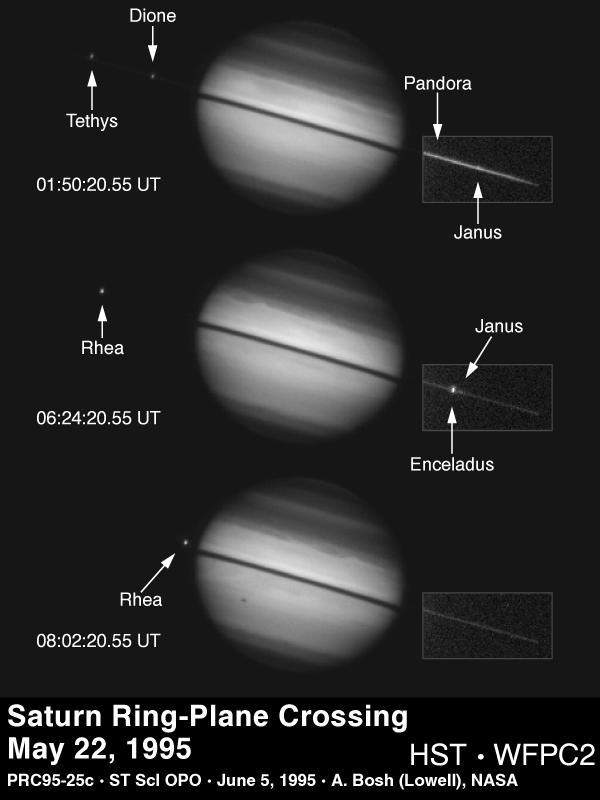
<h1>PIA01277:  Hubble Views Saturn Ring-Plane Crossing (satellites labeled)</h1><div class="PIA01277" lang="en" style="width:600px;text-align:left;margin:auto;background-color:#000;padding:10px;max-height:150px;overflow:auto;"><p>This sequence of images from NASA's Hubble Space Telescope documents a rare astronomical alignment—Saturn's magnificent ring system turned edge-on. This occurs when the Earth passes through Saturn's ring plane, as it does approximately every 15 years.<p>These pictures were taken with Hubble's Wide Field Planetary Camera 2 on 22 May 1995, when Saturn was at a distance of 919 million miles (1.5 billion kilometers) from Earth. At Saturn, Hubble can see details as small as 450 miles (725 km) across. In each image, the dark band across Saturn is the ring shadow cast by the Sun which is still 2.7 degrees above Saturn's ring plane. The box around the western portion of the rings (to the right of Saturn) in each image indicates the area in which the faint light from the rings has been multiplied through image processing (by a factor of 25) to make the rings more visible.<p>[Top] -<p>This image was taken while the Earth was above the lit face of the rings. The moons Tethys and Dione are visible to the east (left) of Saturn; Janus is the bright spot near the center of the ring portion in the box, and Pandora is faintly visible just inside the left edge of this box. Saturn's atmosphere shows remarkable detail: multiple banding in both the northern and southern hemispheres, wispy structure at the north edge of the equatorial zone, and a bright area above the ring shadow that is caused by sunlight scattered off the rings onto the atmosphere. There is evidence of a faint polar haze over the north pole of Saturn and a fainter haze over the south.<p>[Center] -<p>This image was taken close to the time of ring-plane crossing. The rings are 75% fainter than in the top image, though they do not disappear completely because the vertical face of the rings still reflects sunlight when the rings are edge-on. Rhea is visible to the east of Saturn, Enceladus is the bright satellite in the rings to the west, and Janus is the fainter blip to its right. Pandora is just to the left of Enceladus, but is not visible because Enceladus is too bright. An oval-shaped atmospheric feature has just rotated into view (near the eastern limb, at the northern edge of the equatorial zone), and appears to be a local circulation pattern that is not penetrated by the bright clouds that are deflected around it.<p>[Bottom] -<p>This image was taken approximately 96 minutes (one Hubble orbit) after the center image. The rings are 10% brighter than they were in that image. Rhea is visible just off the eastern limb of Saturn, and casts a shadow on the south face of Saturn. During this exposure, the Earth and Sun were on opposite sides of Saturn's ring plane (they remain in this configuration until 10 August 1995). The atmospheric circulation pattern has rotated to just past the center of the planet's disk, and is followed by more wispy structure in the bright band of clouds, reminiscent of the structure seen during the Saturn storm observed in 1990.<p>These images will be used to determine the time of ring-plane crossing and the thickness of the main rings and to search for as yet undiscovered satellites. Knowledge of the exact time of ring-plane crossing will lead to an improved determination of the rate at which Saturn "wobbles" about its axis (polar precession).<p>Technical Notes Each of these images is a 7-second exposure at 8922 Angstroms in a methane absorption band. North is up and east is to the left.<p>The Wide Field/Planetary Camera 2 was developed by the Jet Propulsion Laboratory and managed by the Goddard Space Flight Center for NASA's Office of Space Science.<p>This image and other images and data received from the Hubble Space Telescope are posted on the World Wide Web on the Space Telescope Science Institute home page at URL <a href="http://oposite.stsci.edu/" class="external free" target="wpext">http://oposite.stsci.edu/</a>.<br /><br /><a href="http://photojournal.jpl.nasa.gov/catalog/PIA01277" onclick="window.open(this.href); return false;" title="Voir l'image 	 PIA01277:  Hubble Views Saturn Ring-Plane Crossing (satellites labeled)	  sur le site de la NASA">Voir l'image 	 PIA01277:  Hubble Views Saturn Ring-Plane Crossing (satellites labeled)	  sur le site de la NASA.</a></div>
PIA01277: Hubble Views Saturn Ring-Plane Crossing (satellites labeled)
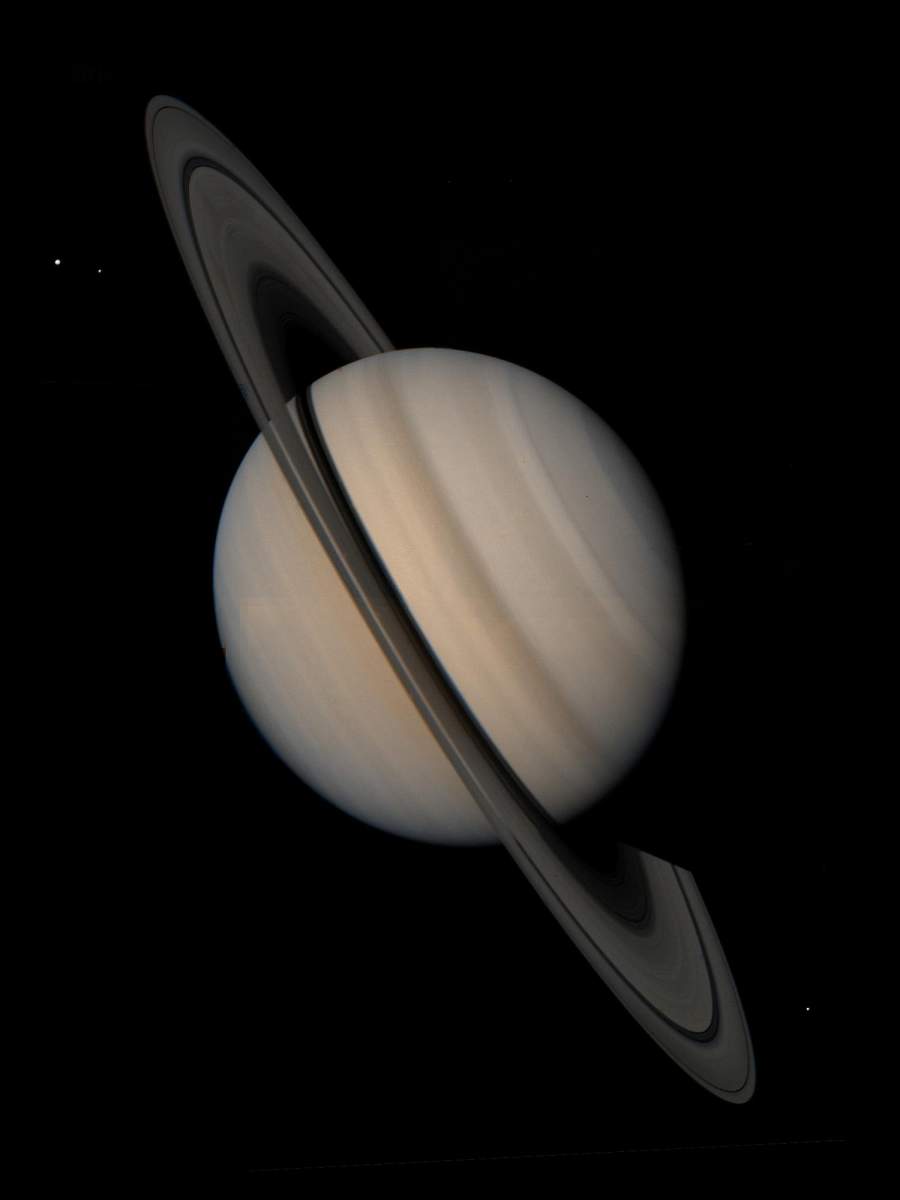
<h1>PIA01364:  Saturn taken from Voyager 2</h1><div class="PIA01364" lang="en" style="width:800px;text-align:left;margin:auto;background-color:#000;padding:10px;max-height:150px;overflow:auto;"><a href="/figures/PIA01364_fig1.jpg"> </a><br /><p>Saturn Storms Observed by Voyager, August 5, 2004</br>Voyager 1 and 2 observed radio signals from lightning which were interpreted as being from a persistent, low-latitude storm system which was extended in longitude, perhaps similar to the region highlighted on this Voyager 2 image acquired on Aug. 4, 1981, from a distance of 21 million kilometers (13 million miles). </p><p>Similar lightning detections by Cassini suggest a much more variable pattern of storms which come and go on time scales of days. The differences may be explained, in part, by stark differences in the shadows cast by the rings between the Voyager and Cassini eras. This image was previously released on December 5, 1998 (see Original Caption).</p><p>The Cassini-Huygens mission is a cooperative project of NASA, the European Space Agency and the Italian Space Agency. The Jet Propulsion Laboratory, a division of the California Institute of Technology in Pasadena, manages the Cassini-Huygens mission for NASA's Science Mission Directorate, Washington, D.C. The Cassini orbiter was designed, developed and assembled at JPL. The radio and plasma wave science team is based at the University of Iowa, Iowa City.</p><p>For more information about the Cassini-Huygens mission, visit <a href="http://saturn.jpl.nasa.gov">http://saturn.jpl.nasa.gov</a> and the instrument team's home page, <a href="http://www-pw.physics.uiowa.edu/plasma-wave/cassini/home.html">http://www-pw.physics.uiowa.edu/plasma-wave/cassini/home.html</a>.<p><br /><br /><a href="http://photojournal.jpl.nasa.gov/catalog/PIA01364" onclick="window.open(this.href); return false;" title="Voir l'image 	 PIA01364:  Saturn taken from Voyager 2	  sur le site de la NASA">Voir l'image 	 PIA01364:  Saturn taken from Voyager 2	  sur le site de la NASA.</a></div>
PIA01364: Saturn taken from Voyager 2
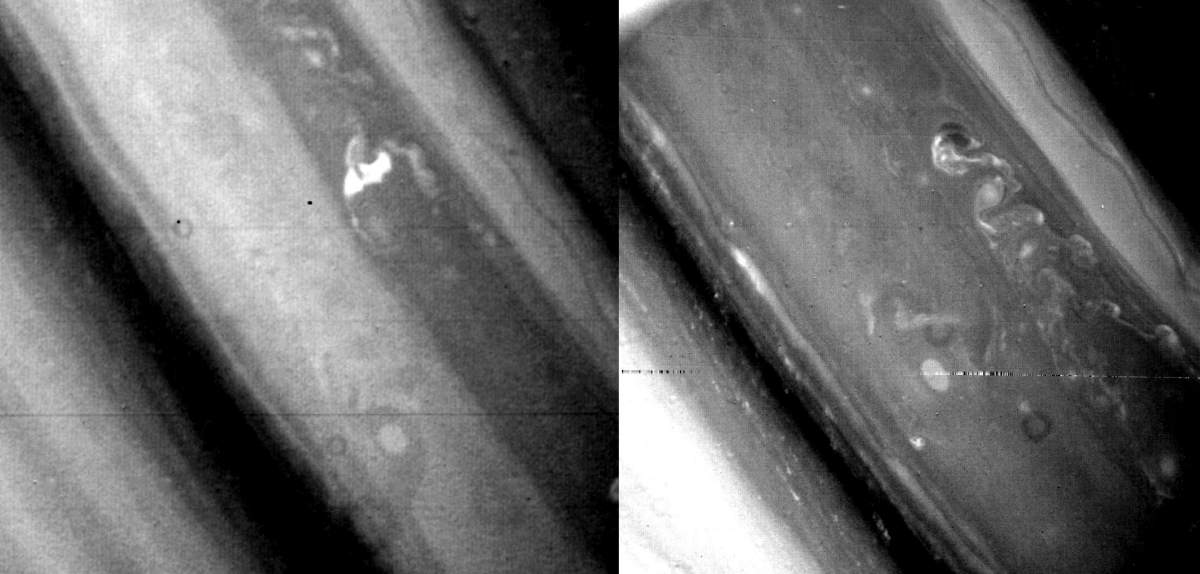
<h1>PIA01375:  Saturn's north temperate region</h1><div class="PIA01375" lang="en" style="width:800px;text-align:left;margin:auto;background-color:#000;padding:10px;max-height:150px;overflow:auto;">This comparison shows Saturn’s north temperate region as viewed Nov. 5, 1980, by Voyager 1 (left) and Aug. 21 by its sister craft, Voyager 2, from a range of 5 million kilometers (3.1 million miles). The large bright oval feature in the lower right of each frame measures about 2,500 km. (1,550 mi.) across. This feature, a gigantic storm system in the planet’s atmosphere, was first observed by Voyager 1 almost exactly one year ago. Thus, as on Jupiter, some storms in Saturn’s atmosphere are quite long-lived compared to their smaller terrestrial counterparts. By contrast, the pattern of convective disturbances to the north (upper right) undergoes rapid changes in a matter of even a few days. In some respects, these features resemble gigantic thunderstorms. The largest bright feature in the Voyager 1 photograph extends about 7,500 km. (4,650 mi.) from north to south. These giant storms lie within one of the strongest westward-flowing currents observed in the atmosphere, with wind speeds of about 20 meters-per-second (45 mph). The smallest visible features here are about 100 km. (62 mi.) across. The Voyager project is managed for NASA by the Jet Propulsion Laboratory, Pasadena, Calif.<br /><br /><a href="http://photojournal.jpl.nasa.gov/catalog/PIA01375" onclick="window.open(this.href); return false;" title="Voir l'image 	 PIA01375:  Saturn's north temperate region	  sur le site de la NASA">Voir l'image 	 PIA01375:  Saturn's north temperate region	  sur le site de la NASA.</a></div>
PIA01375: Saturn's north temperate region
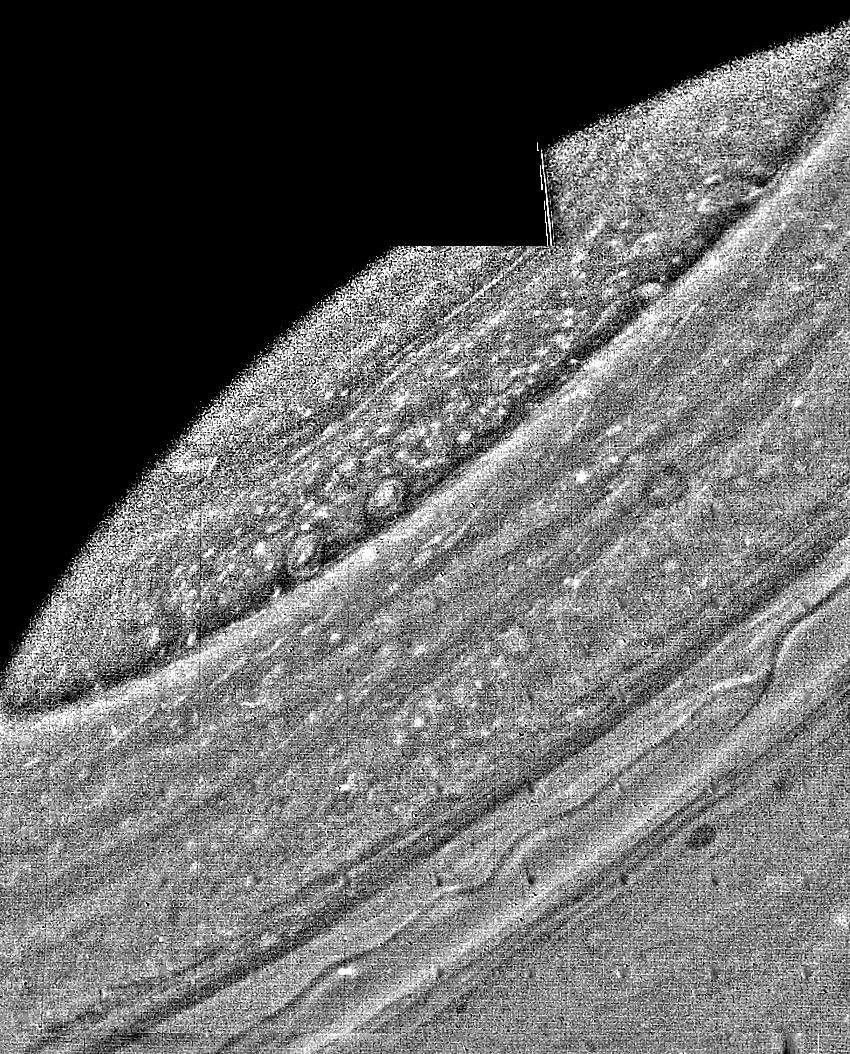
<h1>PIA01376:  Voyager 2 image of Saturn</h1><div class="PIA01376" lang="en" style="width:800px;text-align:left;margin:auto;background-color:#000;padding:10px;max-height:150px;overflow:auto;">This Voyager 2 image of Saturn, obtained Aug. 21 from a distance of 5.4 million kilometers (3.4 million miles), shows further evidence of weather patterns at all latitudes. A stream of clouds is moving in the westward flow at about 15 meters-per-second (33 mph). The clouds are attached to a large spot about 3,000 km. (1,900 mi.) in diameter; the spot moves eastward at about 30 meters-per-second (65 mph) and shows the anti-cyclonic rotation of the combined features. Another spot is seen to the east of the larger cloud, with a similar anti-cyclonic rotation. This ribbonlike feature seen in the latitude band centered at 47 north marks a high-speed jet of about 150 meters-per-second (330 mph). Further small-scale clouds are evident toward the polar region (upper right). The Voyager project is managed for NASA by the Jet Propulsion Laboratory, Pasadena, Calif.<br /><br /><a href="http://photojournal.jpl.nasa.gov/catalog/PIA01376" onclick="window.open(this.href); return false;" title="Voir l'image 	 PIA01376:  Voyager 2 image of Saturn	  sur le site de la NASA">Voir l'image 	 PIA01376:  Voyager 2 image of Saturn	  sur le site de la NASA.</a></div>
PIA01376: Voyager 2 image of Saturn
<h1>PIA01377:  Photographic mosaic of Saturn</h1><div class="PIA01377" lang="en" style="width:800px;text-align:left;margin:auto;background-color:#000;padding:10px;max-height:150px;overflow:auto;">This photographic mosaic of Saturn is the result of the processing of three green-filter frames obtained Aug. 20, when Voyager 2 was 5.7 million kilometers (3.4 million miles) from the planet. At this resolution, the smallest visible features are 100 km. (60 mi.) across. This photograph illustrates the type of processing that can be used to obtain data concerning wind speeds and the evolution of individual cloud pairs. For these purposes, selected sets of data spanning known time intervals are used. Because the image processors are not enhancing three colors equally to compose a single color image, they are free to stretch and filter the data to maximize the visible structure of the color that shows the greatest contrast. The Voyager project is managed for NASA by the Jet Propulsion Laboratory, Pasadena, Calif.<br /><br /><a href="http://photojournal.jpl.nasa.gov/catalog/PIA01377" onclick="window.open(this.href); return false;" title="Voir l'image 	 PIA01377:  Photographic mosaic of Saturn	  sur le site de la NASA">Voir l'image 	 PIA01377:  Photographic mosaic of Saturn	  sur le site de la NASA.</a></div>
PIA01377: Photographic mosaic of Saturn
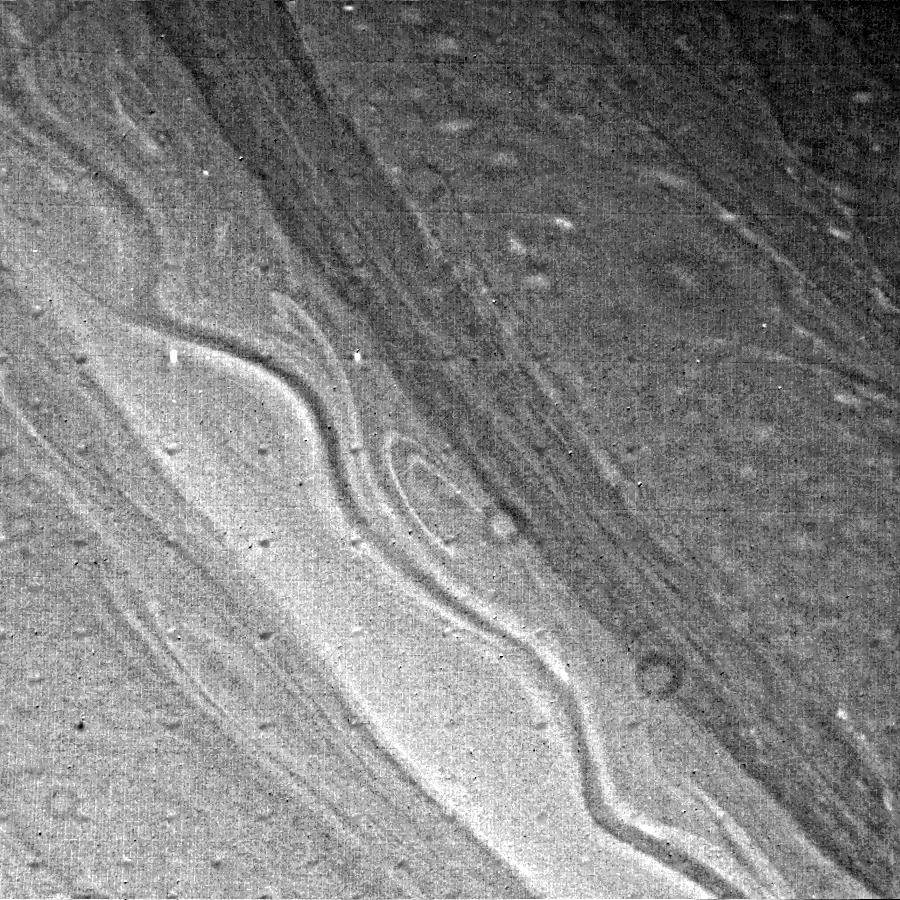
<h1>PIA01378:  Saturn's ribbonlike cloud structure</h1><div class="PIA01378" lang="en" style="width:800px;text-align:left;margin:auto;background-color:#000;padding:10px;max-height:150px;overflow:auto;">The extensive ribbonlike cloud structure in Saturn's atmosphere is visible in this Voyager 2 green-filter photograph, obtained Aug. 23 from a range of 2.5 million kilometers (1.6 million miles). Some Voyager scientists have interpreted the ribbon to be a large-scale atmospheric wave; it is believed to lie in a rapid eastward-moving jet stream. The presence of vortices adjacent to the ribbon itself will help scientists understand the relationship between such structures and the strong jet-streams present in Saturn's atmosphere. The smallest features visible in this photograph measure about 50 km. (30 mi.) across. The Voyager project is managed for NASA by the Jet Propulsion Laboratory, Pasadena, Calif.<br /><br /><a href="http://photojournal.jpl.nasa.gov/catalog/PIA01378" onclick="window.open(this.href); return false;" title="Voir l'image 	 PIA01378:  Saturn's ribbonlike cloud structure	  sur le site de la NASA">Voir l'image 	 PIA01378:  Saturn's ribbonlike cloud structure	  sur le site de la NASA.</a></div>
PIA01378: Saturn's ribbonlike cloud structure
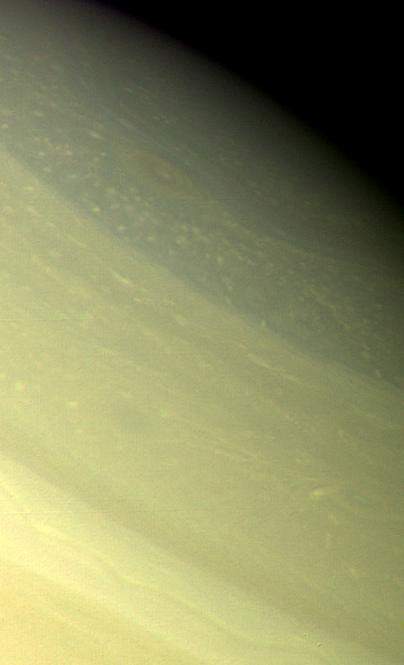
<h1>PIA01379:  Saturnian atmospheric storm</h1><div class="PIA01379" lang="en" style="width:404px;text-align:left;margin:auto;background-color:#000;padding:10px;max-height:150px;overflow:auto;">A vortex, or large atmospheric storm, is visible at 74` north latitude in this color composite of Voyager 2 Saturn images obtained Aug. 25 from a range of 1 million kilometers (620,000 miles). Three wide-angle-camera images taken through green, orange and blue filters were used. This particular storm system seems to be one of the few large-scale structures in Saturn's polar region, which otherwise is dominated by much smaller-scale features suggesting convection. The darker, bluish structure (upper right) oriented east to west strongly suggests the presence of a jet stream at these high latitudes. The appearance of a strong east-west flow in the polar-region could have a major influence on models of Saturn's atmospheric circulation, if the existence of such a flow can be substantiated in time sequences of Voyager images. The smallest features visible in this photograph are about 20 km. (12 mi.) across. The Voyager project is managed for NASA by the Jet Propulsion Laboratory, Pasadena, Calif.<br /><br /><a href="http://photojournal.jpl.nasa.gov/catalog/PIA01379" onclick="window.open(this.href); return false;" title="Voir l'image 	 PIA01379:  Saturnian atmospheric storm	  sur le site de la NASA">Voir l'image 	 PIA01379:  Saturnian atmospheric storm	  sur le site de la NASA.</a></div>
PIA01379: Saturnian atmospheric storm
<h1>PIA01383:  Saturn and its satellites Tethys, Enceladus and Mimas</h1><div class="PIA01383" lang="en" style="width:800px;text-align:left;margin:auto;background-color:#000;padding:10px;max-height:150px;overflow:auto;"><p>Saturn and its satellites Tethys (outer left), Enceladus (inner left) and Mimas (right of rings) are seen in this mosaic of images taken by NASA's Voyager 1 on Oct. 30, 1980 from a distance of 18 million kilometers (11 million miles). The soft, velvety appearance of the low-contrast banded structure and increased reflection of blue light near the perimeter of the Saturn disk are due to scattering by a haze layer above the planet's cloud deck. Features larger than 350 kilometers (220 miles) are visible. The projected width of the rings at the center of the disk is 10,000 kilometers (6,000 miles), which provides a scale for estimating feature sizes on the image.<br /><br /><a href="http://photojournal.jpl.nasa.gov/catalog/PIA01383" onclick="window.open(this.href); return false;" title="Voir l'image 	 PIA01383:  Saturn and its satellites Tethys, Enceladus and Mimas	  sur le site de la NASA">Voir l'image 	 PIA01383:  Saturn and its satellites Tethys, Enceladus and Mimas	  sur le site de la NASA.</a></div>
PIA01383: Saturn and its satellites Tethys, Enceladus and Mimas
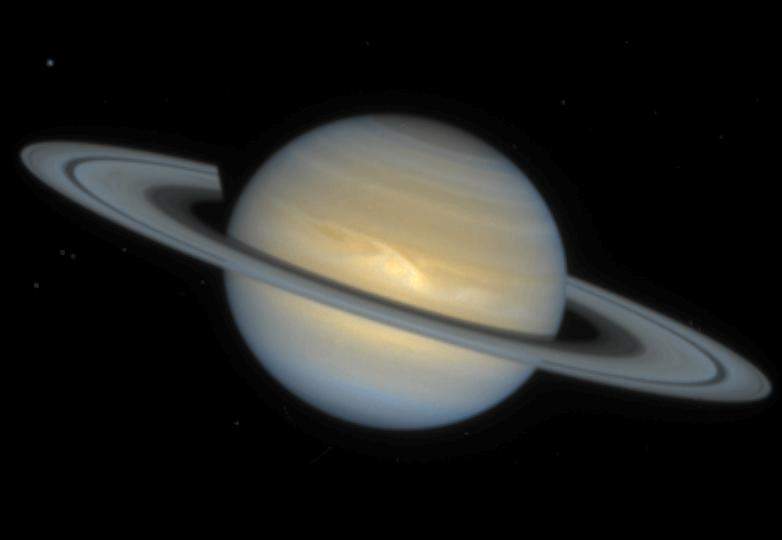
<h1>PIA01464:  Hubble Observes a New Saturn Storm</h1><div class="PIA01464" lang="en" style="width:782px;text-align:left;margin:auto;background-color:#000;padding:10px;max-height:150px;overflow:auto;"><p>This NASA Hubble Space Telescope image of the ringed planet Saturn shows a rare storm that appears as a white arrowhead-shaped feature near the planet's equator. The storm is generated by an upwelling of warmer air, similar to a terrestrial thunderhead. The east-west extent of this storm is equal to the diameter of the Earth (about 7,900 miles). Hubble provides new details about the effects of Saturn's prevailing winds on the storm. The new image shows that the storm's motion and size have changed little since its discovery in September, 1994.<p>The storm was imaged with Hubble's Wide Field Planetary Camera 2 (WFPC2) in the wide field mode on December 1, 1994, when Saturn was 904 million miles from the Earth. The picture is a composite of images taken through different color filters within a 6 minute interval to create a "true-color" rendition of the planet. The blue fringe on the right limb of the planet is an artifact of image processing used to compensate for the rotation of the planet between exposures.<p>The Hubble images are sharp enough to reveal that Saturn's prevailing winds shape a dark "wedge" that eats into the western (left) side of the bright central cloud. The planet's strongest eastward winds (clocked at 1,000 miles per hour from analysis of Voyager spacecraft images taken in 1980-81) are at the latitude of the wedge.<p>To the north of this arrowhead-shaped feature, the winds decrease so that the storm center is moving eastward relative to the local flow. The clouds expanding north of the storm are swept westward by the winds at higher latitudes. The strong winds near the latitude of the dark wedge blow over the northern part of the storm, creating a secondary disturbance that generates the faint white clouds to the east (right) of the storm center.<p>The storm's white clouds are ammonia ice crystals that form when an upward flow of warmer gases shoves its way through Saturn's frigid cloud tops. This current storm is larger than the white clouds associated with minor storms that have been reported more frequently as bright cloud features.<p>Hubble observed a similar, though larger, storm in September 1990, which was one of three major Saturn storms seen over the past two centuries. Although these events were separated by about 57 years (approximately 2 Saturnian years) there is yet no explanation why they apparently follow a cycle -- occurring when it is summer in Saturn's northern hemisphere.<p>The Wide Field/Planetary Camera 2 was developed by the Jet Propulsion Laboratory and managed by the Goddard Space Flight Center for NASA's Office of Space Science.<p>This image and other images and data received from the Hubble Space Telescope are posted on the World Wide Web on the Space Telescope Science Institute home page at URL <a href="http://oposite.stsci.edu/" class="external free" target="wpext">http://oposite.stsci.edu/</a>.<br /><br /><a href="http://photojournal.jpl.nasa.gov/catalog/PIA01464" onclick="window.open(this.href); return false;" title="Voir l'image 	 PIA01464:  Hubble Observes a New Saturn Storm	  sur le site de la NASA">Voir l'image 	 PIA01464:  Hubble Observes a New Saturn Storm	  sur le site de la NASA.</a></div>
PIA01464: Hubble Observes a New Saturn Storm
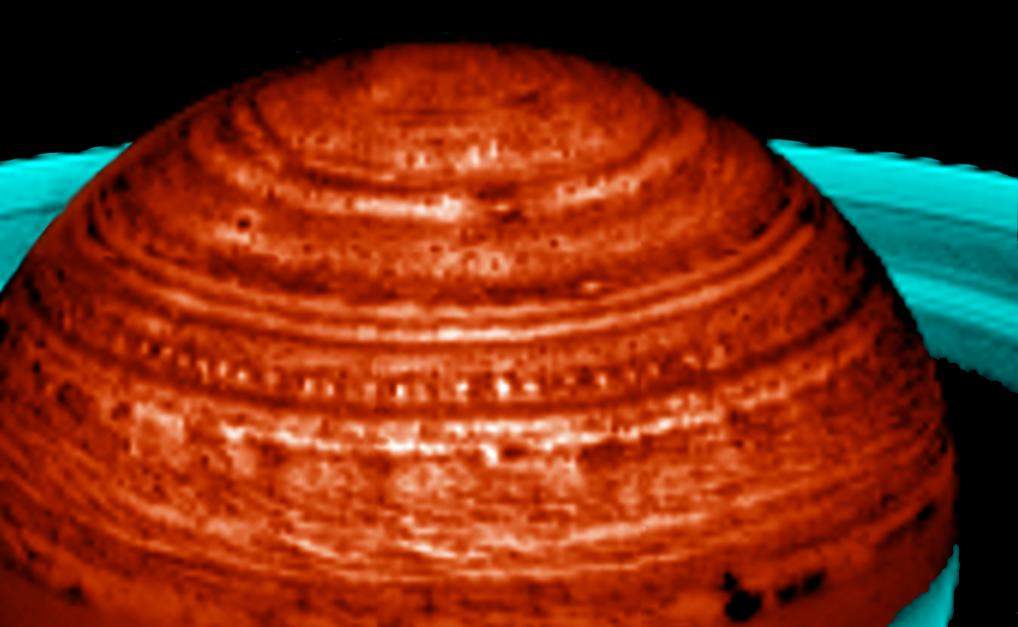
<h1>PIA01941:  String of Pearls</h1><div class="PIA01941" lang="en" style="width:800px;text-align:left;margin:auto;background-color:#000;padding:10px;max-height:150px;overflow:auto;"><p><a href="/figures/PIA01941_fig1.jpg"></a><br />Black and White Image</p><p>In this image, Saturn's fascinating meteorology manifests itself in a "string of pearls" formation, spanning over 60,000 kilometers (37,000 miles). </p><p>Seen in new images acquired by Cassini's visual and infrared mapping spectrometer and lit from below by Saturn's internal thermal glow, the bright "pearls" are actually clearings in Saturn's deep cloud system. More than two dozen occur at 40 degrees north latitude. Each clearing follows another at a regular spacing of some 3.5 degrees in longitude. </p><p>This is the first time such a regular and extensive train of cloud-clearings has been observed. The regularity indicates that they may be a manifestation of a large planetary wave. Scientists plan to take more observations of this phenomenon over the next few years to try to understand Saturn's deep circulation systems and meteorology. This image was taken on April 27, 2006.</p><p>The Cassini-Huygens mission is a cooperative project of NASA, the European Space Agency and the Italian Space Agency. The Jet Propulsion Laboratory, a division of the California Institute of Technology in Pasadena, manages the mission for NASA's Science Mission Directorate, Washington, D.C. The visual and infrared mapping spectrometer team is based at the University of Arizona where this image was produced.</p><p>For more information about the Cassini-Huygens mission <a href="http://saturn.jpl.nasa.gov">http://saturn.jpl.nasa.gov/home/index.cfm</a> The visual and infrared mapping spectrometer team homepage is at <a href="http://wwwvims.lpl.arizona.edu">http://wwwvims.lpl.arizona.edu</a>.</p><br /><br /><a href="http://photojournal.jpl.nasa.gov/catalog/PIA01941" onclick="window.open(this.href); return false;" title="Voir l'image 	 PIA01941:  String of Pearls	  sur le site de la NASA">Voir l'image 	 PIA01941:  String of Pearls	  sur le site de la NASA.</a></div>
PIA01941: String of Pearls
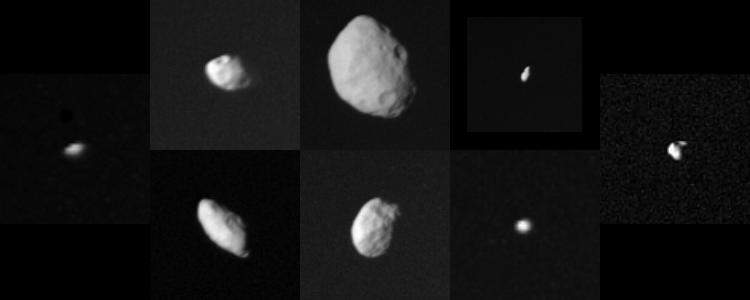
<h1>PIA01954:  Collage of Saturn's smaller satellites</h1><div class="PIA01954" lang="en" style="width:750px;text-align:left;margin:auto;background-color:#000;padding:10px;max-height:150px;overflow:auto;">This family portrait shows the smaller satellites of Saturn as viewed by Voyager 2 during its swing through the Saturnian system. The following chart corresponds to this composite photograph (distance from the planet increases from left to right) and lists names, standard numerical designations and approximate dimensions (radii where indicated) in kilometers:<p>  1980S26<p>Outer F-ring<p>shepherd<p>120 X 100  1980S1<p>Leading<p>co-orbital<p>220 X 160 1980S25<p>Trailing<p>Tethys trojan<p>radii: 25 1980S28<p>Outer A<p>shepherd<p>radii: 20 1980S27<p>Inner F-ring<p>co-orbital<p>145 X 70 1980S3<p>Trailing<p>Tethys trojan<p>140 X 100 1980S13<p>Leading<p>Tethys trojan<p>radii: 30 1980S6<p>Leading<p>Dione trojan<p>radii: 30 These images have been scaled to show the satellites in true relative sizes. This set of small objects ranges in size from small asteroidal scales to nearly the size of Saturn's moon Mimas. They are probably fragments of somewhat larger bodies broken up during the bombardment period that followed accretion of the Saturnian system. Scientists believe they may be mostly icy bodies with a mixture of meteorite rock. They are somewhat less reflective than the larger satellites, suggesting that thermal evolution of the larger moons "cleaned up" their icy surfaces. The Voyager project is managed for NASA by the Jet Propulsion Laboratory, Pasadena, Calif.<br /><br /><a href="http://photojournal.jpl.nasa.gov/catalog/PIA01954" onclick="window.open(this.href); return false;" title="Voir l'image 	 PIA01954:  Collage of Saturn's smaller satellites	  sur le site de la NASA">Voir l'image 	 PIA01954:  Collage of Saturn's smaller satellites	  sur le site de la NASA.</a></div>
PIA01954: Collage of Saturn's smaller satellites
<h1>PIA01956:  Voyager 2 image of Saturn</h1><div class="PIA01956" lang="en" style="width:594px;text-align:left;margin:auto;background-color:#000;padding:10px;max-height:150px;overflow:auto;">This Voyager 2 image, taken Aug. 18 from a distance of 6.8 million kilometers (4.2 million miles), shows the region extending from 20 north latitude to Saturn’s polar region. Several small-scale spots evident at around 37 north move in an easterly jet at a speed approaching 15 meters-per-second (33 mph). Toward the boundary with the white cloud band are several cloud strands that mark part of the westerly flow of the atmosphere. This flow reaches a maximum in the “ribbonlike” structure, with wind speeds of about 150 meters-per-second (330 mph). Further cloud bands and small-scale spots can be seen toward Saturn’s north pole. The smallest features evident here measure about 65 km. (40 mi.) across. The Voyager project is managed for NASA by the Jet Propulsion Laboratory, Pasadena, Calif.<br /><br /><a href="http://photojournal.jpl.nasa.gov/catalog/PIA01956" onclick="window.open(this.href); return false;" title="Voir l'image 	 PIA01956:  Voyager 2 image of Saturn	  sur le site de la NASA">Voir l'image 	 PIA01956:  Voyager 2 image of Saturn	  sur le site de la NASA.</a></div>
PIA01956: Voyager 2 image of Saturn
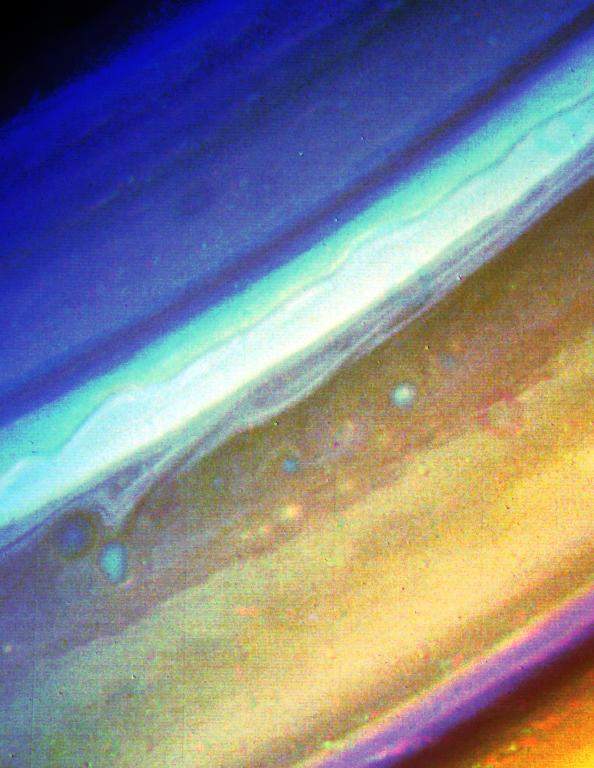
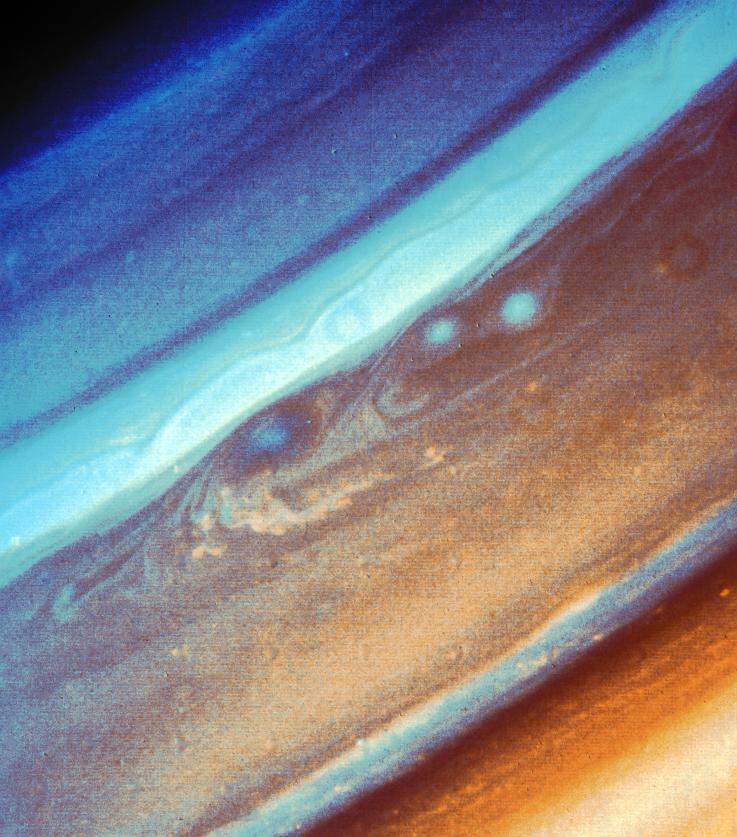
<h1>PIA01957:  Photograph of Saturn constructed in false color</h1><div class="PIA01957" lang="en" style="width:737px;text-align:left;margin:auto;background-color:#000;padding:10px;max-height:150px;overflow:auto;">This Saturn photograph has been constructed in false color from a green and a violet frame obtained Aug. 19 by Voyager 2 from a range of 7.1 million kilometers (4.4 million miles). In true color, the blue oval in the center of the image would be brown and the two spots below and to the right would be white. The convective structure below the blue oval is moving west at 20 meters-per-second (40 mph) relative to the oval. The wavelike structures in the ribbon to the north are moving eastward at 150 meters-per-second (300 mph). In this image, the smallest observable features are 130 km. (80 mi.) across. The separate green and violet frames used to construct this picture are displayed in an accompanying release (P-23916BW, S-2-13). The Voyager project is managed for NASA by the Jet Propulsion Laboratory, Pasadena, Calif.<br /><br /><a href="http://photojournal.jpl.nasa.gov/catalog/PIA01957" onclick="window.open(this.href); return false;" title="Voir l'image 	 PIA01957:  Photograph of Saturn constructed in false color	  sur le site de la NASA">Voir l'image 	 PIA01957:  Photograph of Saturn constructed in false color	  sur le site de la NASA.</a></div>
PIA01957: Photograph of Saturn constructed in false color

Page 1 de 13

  • 1
  • 2
  • 3
  • 4
  • 5
  • 6
  • 7
  • Suivante
  • Dernière »

Faire un site internet avec le CMS Contao • Création de sites internet professionnels
Online
En ligne:
70
Visites aujourd'hui :
859
Total des visites :
570,656
Clics aujourd'hui:
2,683
Total des clics :
1,599,678
Visiteurs par jour: Ø
1,544
Collecte depuis:
 01 02 2011